
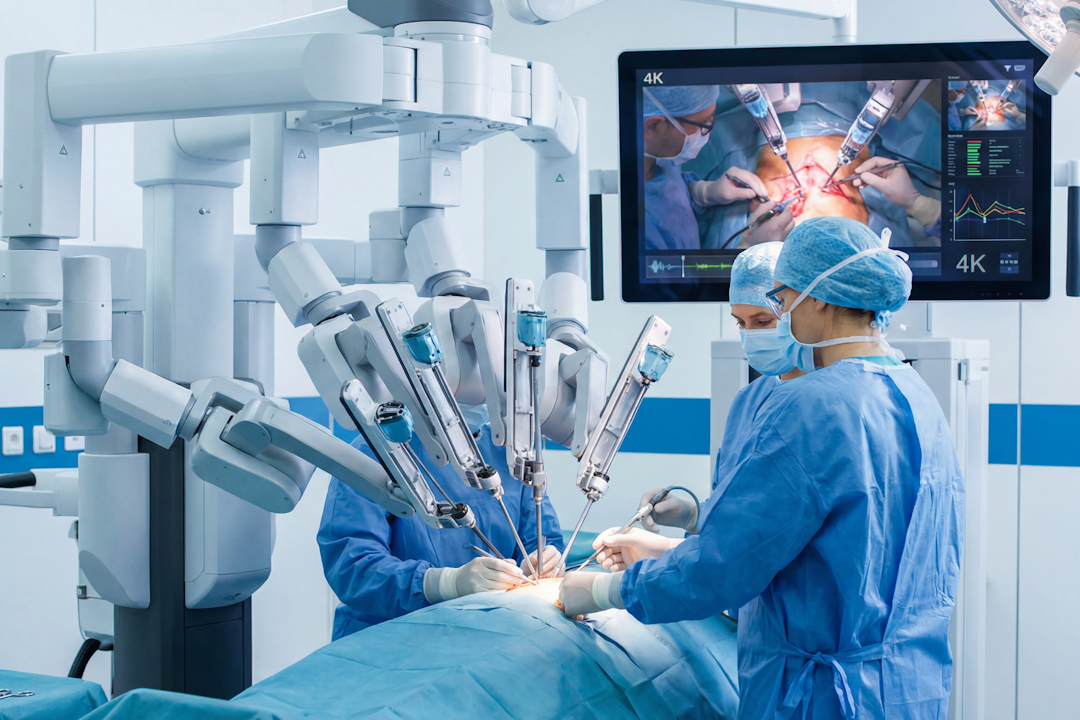
Robotics has quietly become one of the most consequential technologies in modern medicine. From robotic-assisted surgical systems that extend a surgeon’s precision beyond human physical limits to autonomous mobile robots handling hospital logistics, medical robotics is expanding well beyond the operating room. The sector combines the technical demands of precision robotics with the regulatory rigor of medical device development, creating a distinctive investment category with high barriers to entry and durable competitive advantages for companies that clear those barriers successfully.
The Case for Robotic Surgery
Robotic-assisted surgical systems allow a surgeon to control precision instruments through a console, translating hand movements into scaled, tremor-filtered motion at the surgical site. This translation provides capabilities that exceed unassisted human hands: the elimination of natural hand tremor, motion scaling that allows large, comfortable surgeon movements to translate into extremely fine instrument motion, and articulated instrument wrists that can achieve angles and access points that rigid, hand-held laparoscopic instruments cannot reach.
The clinical evidence supporting robotic surgery has matured substantially since the first systems received regulatory approval. For specific procedure types — particularly complex procedures in confined anatomical spaces such as prostate surgery and certain gynecological and thoracic procedures — robotic assistance has demonstrated measurable advantages in precision, blood loss, and recovery time compared to both open surgery and conventional laparoscopic techniques. For other procedure types, the clinical advantage over conventional laparoscopic surgery is less clearly established, and the additional cost of robotic systems must be weighed against more modest incremental clinical benefit.
The economics of robotic surgical systems follow a razor-and-blade model: hospitals make a substantial capital investment in the robotic system itself, then generate recurring revenue for the manufacturer through the disposable and semi-disposable instruments consumed with each procedure. This business model creates highly predictable, recurring revenue streams once a system is installed and adopted into a hospital’s surgical workflow, and it creates meaningful switching costs that favor incumbent system providers over new entrants.
Beyond the Operating Room
Rehabilitation robotics — powered exoskeletons and robotic therapy devices that assist patients recovering from stroke, spinal cord injury, or orthopedic surgery — represent a growing application of robotics in the recovery phase of patient care. These systems can provide more consistent, measurable, and intensive therapy than manual physical therapy alone, while generating objective data on patient progress that supports more precise treatment adjustment over the course of rehabilitation.
Hospital logistics robotics — autonomous mobile robots that transport medications, supplies, and laboratory samples throughout hospital facilities — address a less visible but economically significant application of medical robotics. Hospital staff, particularly nurses, spend a meaningful portion of their time on logistics tasks that autonomous robots can perform, freeing clinical staff for direct patient care. The return on investment for hospital logistics automation is measurable in labor cost savings and, increasingly important given healthcare staffing shortages, in reduced burden on clinical staff.
Diagnostic and interventional robotics, including robotic systems for minimally invasive catheter-based procedures in cardiology and neurology, represent an expanding frontier of medical robotics beyond traditional surgery. These systems allow physicians to navigate catheters and other instruments through the vascular system with a precision and stability that manual manipulation struggles to match, particularly for complex procedures requiring navigation through tortuous or fragile anatomical pathways.
The Regulatory and Data Moat
Medical robotics companies face a regulatory approval pathway that is substantially more rigorous than most industrial or consumer robotics applications, requiring clinical evidence of safety and efficacy before commercial deployment. This regulatory burden, while slowing time to market, creates a meaningful barrier to entry that protects established players with the resources and expertise to navigate the approval process successfully.
The clinical data generated through years of commercial deployment represents a significant competitive asset for established medical robotics companies. Outcomes data across large numbers of procedures supports both ongoing regulatory engagement and the clinical evidence base that influences hospital purchasing decisions and surgeon training and certification programs. New entrants must build this evidence base from a much smaller installed base, a disadvantage that compounds over time as incumbents’ data advantage grows.
Surgeon training and certification represents a further switching cost specific to surgical robotics. Surgeons trained and credentialed on a specific robotic platform have invested significant time developing proficiency with that system’s specific instrument set and control interface, creating a form of human capital lock-in that reinforces the recurring instrument revenue model and makes hospitals and surgical staff resistant to switching platforms even when a competitive alternative becomes available.
Investing in Medical Robotics
Medical robotics companies command premium valuations relative to general industrial robotics, reflecting the combination of recurring instrument revenue, regulatory barriers to entry, and the clinical data moat that protects established market positions. Evaluating these companies requires assessing procedure volume growth, instrument revenue per procedure, system installation growth, and the trajectory of clinical evidence supporting expansion into new procedure categories.
The competitive landscape in surgical robotics has evolved from a market historically dominated by a small number of established players toward a more competitive environment as patent protections on foundational surgical robotics technology have expired, enabling new entrants with competitive systems. This increased competition is generally favorable for hospital customers through lower pricing and product innovation, while creating more complex competitive dynamics for investors to evaluate across an expanding field of surgical robotics companies.
Adjacent categories — rehabilitation robotics, hospital logistics automation, and interventional robotics — represent earlier-stage but potentially significant opportunities as these technologies work through their own regulatory and clinical validation processes. Companies that can demonstrate clear clinical or economic value in these adjacent categories, supported by credible evidence, are positioned to capture share of healthcare capital spending that is increasingly directed toward technologies that address both clinical outcomes and the persistent staffing challenges facing healthcare systems.
Conclusion
Medical robotics combines the technical sophistication of precision robotics with the durable competitive advantages that regulatory barriers and clinical data moats provide. The expansion of robotics beyond the operating room into rehabilitation, hospital logistics, and interventional procedures broadens the addressable market well past surgical robotics alone. For investors, the sector offers a combination of recurring revenue economics and defensible competitive positions that are relatively rare in the broader robotics investment landscape.
Key Takeaways
- Robotic-assisted surgery provides measurable clinical advantages for specific complex procedures, supported by a razor-and-blade recurring revenue business model.
- Hospital logistics and rehabilitation robotics are expanding medical robotics well beyond the operating room, addressing staffing and recovery challenges.
- Regulatory approval barriers and accumulated clinical data create durable competitive moats that protect established medical robotics companies.
- Surgeon training lock-in reinforces instrument revenue and switching costs, though patent expirations are increasing competitive intensity in surgical robotics.
Editorial Disclosure
This article is produced by NextGenTechStocks.com for informational and educational purposes only. NextGenTechStocks.com has not received any compensation from any company, management team, investor relations representative, or any third party in connection with the publication of this article. No staff member or principal of NextGenTechStocks.com holds a position in any security mentioned in this article at the time of publication. The information presented is based on publicly available sources and is intended to provide general market education only. Investing in technology stocks carries significant risk, including the potential loss of capital. Readers are encouraged to conduct their own due diligence and consult a qualified financial advisor before making any investment decisions. For more information, please see our full Disclaimer at NextGenTechStocks.com.