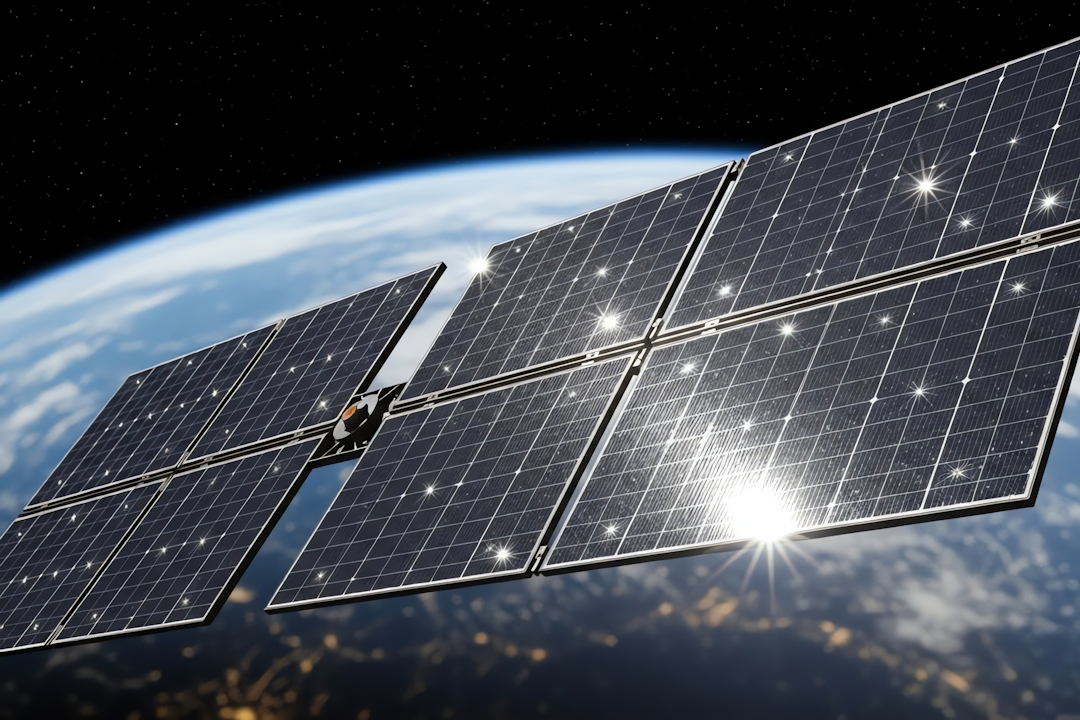
Solar panels in orbit never experience nighttime, weather, or atmospheric absorption — conditions that fundamentally limit terrestrial solar power generation. Space-based solar power, an idea first proposed decades ago but historically dismissed as economically implausible given the cost of space access, is being seriously reconsidered as falling launch costs and advances in wireless power transmission technology narrow the gap between the concept’s theoretical appeal and its practical commercial viability. The technology remains early-stage, but the engineering case has become considerably more credible than it was even a decade ago.
The Theoretical Case for Orbital Solar Power
A solar panel in geostationary orbit receives sunlight with an intensity and consistency that no terrestrial location can match, since orbital solar panels avoid the atmospheric absorption that reduces the sunlight reaching ground-based panels, the day-night cycle that limits terrestrial generation to roughly half the day even in ideal conditions, and the seasonal and weather variability that makes terrestrial solar generation inherently intermittent across most of the planet’s surface.
This theoretical generation advantage has been understood since the concept of space-based solar power was first proposed in the early 1970s, but the economics of the idea depended on two capabilities that remained prohibitively expensive or technically immature for decades: the cost of launching the enormous mass of solar collection infrastructure required for meaningful power generation into orbit, and the efficiency of wirelessly transmitting the collected power back to Earth’s surface across the vast distance separating orbital and terrestrial infrastructure.
Both of these constraints have eased substantially in recent years. The launch cost reductions discussed extensively elsewhere in this publication have directly improved the economics of any concept requiring substantial mass in orbit, while advances in wireless power transmission technology, including both microwave and laser-based approaches, have improved the efficiency with which collected solar energy can be converted to a transmittable form, beamed across the orbital-to-terrestrial distance, and reconverted to usable electricity at a ground receiving station.
The Engineering Challenge of Wireless Power Transmission
Transmitting meaningful quantities of power across the distance between orbit and the Earth’s surface without physical connection requires converting electrical power into a transmittable form of energy, most commonly microwave radiation, directing that energy precisely toward a ground receiving station using large phased-array transmitting antennas, and then converting the received energy back into usable electricity at the ground station using specialized receiving equipment called a rectenna, a portmanteau of rectifying antenna.
The efficiency of this multi-stage conversion and transmission process — electricity to microwave, transmission across vast distance, microwave back to electricity — determines how much of the solar energy collected in orbit ultimately reaches the terrestrial grid as usable power. Efficiency improvements at each stage of this conversion chain have been a primary focus of space-based solar power research programs, since even modest efficiency improvements compound significantly across the multiple conversion stages the overall system requires.
Ground-based receiving infrastructure for space-based solar power requires substantial land area for the rectenna array needed to safely and efficiently capture the transmitted microwave energy, representing a terrestrial infrastructure requirement that partially offsets the land-use advantage that avoiding ground-based solar panel installation might otherwise provide. Research into more compact and efficient receiving technology, along with siting strategies that use land unsuitable for other purposes, is addressing this consideration as the technology moves toward larger demonstration projects.
Recent Technical Progress and Demonstrations
Several government space agencies and private companies have conducted small-scale orbital demonstrations of wireless power transmission technology in recent years, validating key elements of the space-based solar power concept including in-orbit power generation, conversion to a transmittable form, and successful wireless transmission to a ground receiving station, even at power and distance scales far smaller than would be required for commercially meaningful electricity generation.
These demonstration missions represent an important, if still early, validation step analogous to the incremental technology demonstration approach that has characterized other ambitious space technology programs discussed elsewhere in this publication, including in-space manufacturing and lunar resource utilization. The gap between successful small-scale technology demonstration and commercially viable, gigawatt-scale space-based solar power generation remains substantial, requiring orders of magnitude improvement in the scale of both orbital solar collection infrastructure and ground-based receiving capability.
Modular, in-space assembly approaches, building on the robotic servicing and assembly capabilities discussed elsewhere in this publication in the context of satellite servicing, are being explored as a pathway to constructing the large orbital solar collection structures that commercially meaningful space-based solar power would require, since launching a single, pre-assembled structure of the necessary scale would exceed the payload capacity of any current or near-term launch vehicle.
Assessing the Investment Case
Space-based solar power remains a longer-horizon, higher-risk investment theme than most other space economy applications discussed in this publication, given the substantial remaining gap between current technology demonstration scale and the commercial scale required for the concept to meaningfully contribute to terrestrial electricity supply. Investors drawn to this theme should size positions appropriately for a technology still in early-stage validation rather than commercial deployment.
The most direct beneficiaries of continued space-based solar power development, regardless of whether the concept ultimately achieves commercial-scale deployment, are the companies providing the underlying enabling technologies: launch services benefiting from the substantial payload mass that orbital solar infrastructure would require, in-space robotics and assembly technology, and wireless power transmission technology with potential applications beyond space-based solar power alone, including terrestrial wireless charging and power delivery to difficult-to-reach locations.
Government and defense interest in space-based solar power has provided a meaningful source of research funding independent of near-term commercial viability, driven partly by the strategic value of resilient, distributable power delivery for military and disaster response applications where wirelessly transmitting power to a location without existing grid infrastructure offers genuine operational value distinct from the broader clean energy case for the technology.
Conclusion
Space-based solar power represents one of the more ambitious and technically demanding concepts in the broader space economy, offering a theoretically compelling solution to solar power’s fundamental intermittency limitation if the substantial engineering challenges of orbital construction and wireless power transmission can be solved at commercial scale. Recent small-scale demonstrations have provided genuine technical validation, even as the gap to commercially meaningful deployment remains substantial. For investors, the theme rewards patience and a focus on the enabling technologies that benefit from continued development regardless of the ultimate timeline for full-scale commercial space-based solar power.
Key Takeaways
- Orbital solar panels avoid the atmospheric absorption, day-night cycle, and weather variability that fundamentally limit terrestrial solar generation.
- Falling launch costs and improving wireless power transmission efficiency have substantially improved the economics that once made the concept implausible.
- Small-scale orbital demonstrations have validated key technical elements, but the gap to commercial, gigawatt-scale deployment remains substantial.
- Launch services, in-space robotics, and wireless power transmission technology are the most direct beneficiaries regardless of the concept’s ultimate commercial timeline.
Editorial Disclosure
This article is produced by NextGenTechStocks.com for informational and educational purposes only. NextGenTechStocks.com has not received any compensation from any company, management team, investor relations representative, or any third party in connection with the publication of this article. No staff member or principal of NextGenTechStocks.com holds a position in any security mentioned in this article at the time of publication. The information presented is based on publicly available sources and is intended to provide general market education only. Investing in technology stocks carries significant risk, including the potential loss of capital. Readers are encouraged to conduct their own due diligence and consult a qualified financial advisor before making any investment decisions. For more information, please see our full Disclaimer at NextGenTechStocks.com.