
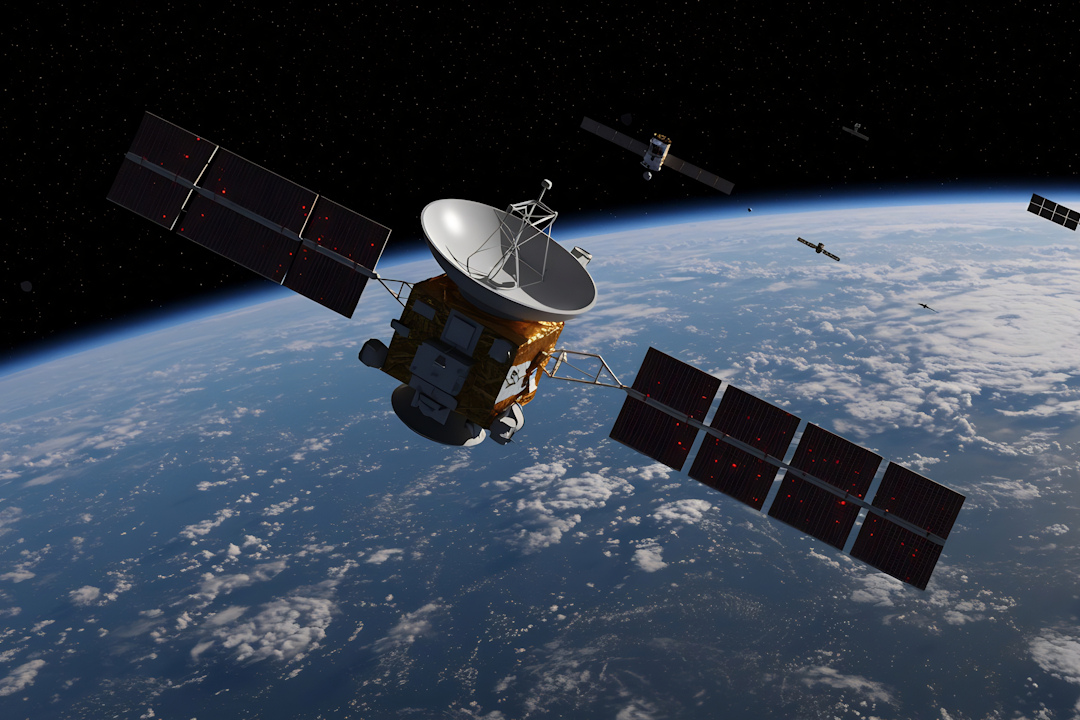
MDA Space Ltd. (TSX: MDA) (NYSE: MDA) confirmed in a press release on August 16 that it successfully launched the first eight of 17 replenishment satellites it is building for Globalstar Inc. (NASDAQ: GSAT), extending the life of Globalstar’s existing low Earth orbit (LEO) satellite network. The launch itself is routine in one sense, satellites go up on rockets regularly, but it marks a specific first for MDA Space: this is the company’s first delivery as prime contractor on a commercial communications constellation, meaning MDA held primary responsibility for the program rather than supplying a component or subsystem to someone else’s project.
What Actually Launched
The eight satellites were developed, fully integrated, and tested at MDA Space’s facility in Montreal before launching aboard a SpaceX Falcon 9 rocket from Space Launch Complex 40 in Cape Canaveral, Florida, on the evening of August 15. They are now in a commissioning phase, a period of in-orbit testing where engineers verify each satellite’s systems are functioning correctly before it’s brought into active service, rather than being usable the moment they reach orbit. That process typically involves checking power systems, communications payloads, and orientation controls under real space conditions, things that can’t be fully validated on the ground no matter how thorough pre-launch testing is. MDA Space says the remaining nine satellites on this order are in the final stages of integration on the ground, putting the full 17-satellite order roughly halfway to being fully in orbit.
Why ‘Prime Contractor’ Is the Real News Here
A prime contractor holds the primary contract for a program and is accountable for its overall delivery, as distinct from a subcontractor performing a defined piece of someone else’s project. For a satellite manufacturer, winning and executing prime contractor roles on commercial programs, rather than mainly building components or subsystems for other companies’ missions, generally means capturing more of a program’s total value and demonstrating the ability to manage an entire mission independently, from design through launch and into operation. That distinction matters for how a company like MDA Space grows: a subsystem supplier’s revenue is tied to whatever piece of a mission it builds, while a prime contractor captures the value of the full program and takes on correspondingly more schedule and delivery risk if something goes wrong. MDA Space’s own materials describe this shift as tied to a broader transformation in its design and manufacturing process, including a new high-volume production facility the company says is now operational.
Replenishment, Not a New Constellation
It’s worth distinguishing this launch from MDA Space’s other recent satellite news: its expanded contract with Telesat covers new satellites for an expanding Lightspeed broadband constellation, while these Globalstar satellites are replenishment units, meaning they’re designed to replace aging or failing satellites and extend the operational life of a network that already exists, rather than growing the constellation’s overall size or capacity. That’s a fundamentally different kind of program: a replenishment order depends on an existing operator’s older satellites reaching the end of their working life on a predictable schedule, rather than on an operator deciding to expand into new markets or add capacity. Globalstar’s existing LEO network supports direct-to-device satellite connectivity, letting select standard mobile phones connect to satellites without specialized hardware, along with IoT (Internet of Things) applications like remote asset tracking and sensor networks that need connectivity outside normal cellular coverage, use cases that depend on the constellation staying operational continuously rather than on it growing larger.
What MDA Space Is Saying About Its Own Growth
MDA Space CEO Mike Greenley framed this program as evidence of a broader transformation in how the company builds satellites, crediting an accelerated development and manufacturing process along with the company’s new high-volume production facility for giving MDA more capacity to take on additional commercial work as demand grows. That’s the company’s own characterization of its strategic position, not an independently verified claim about market demand or MDA’s manufacturing capacity relative to competitors, and the release doesn’t specify production output figures, throughput targets, or a location for the new facility beyond confirming these particular satellites were built in Montreal.
What’s Still Uncertain
MDA Space’s own forward-looking statement in the release specifically flags the completion of the commissioning process, final completion of the full Globalstar program, and integration of the delivered satellites into Globalstar’s existing constellation as forward-looking and subject to change, tied to risk factors detailed in the company’s annual information form and its quarterly filings. In practical terms, a successful launch is a meaningful milestone, but it isn’t the same as confirming the satellites are fully operational or that the remaining nine satellites will ship on the timeline the company currently expects. Commissioning failures on new satellites do happen in the industry, even after a clean launch, so the period between now and full operational status is not purely a formality.
Sources
MDA Space Satellites for Globalstar Successfully Launched, PRNewswire, August 16, 2026.
Editorial Disclosure
This article is based on a press release issued by MDA Space Ltd. on August 16, 2026, distributed via PRNewswire. Securities discussed: MDA Space Ltd. (TSX: MDA) (NYSE: MDA) and Globalstar Inc. (NASDAQ: GSAT). Next Gen Tech Stocks has not received compensation from MDA Space, Globalstar, their management, investor relations representatives, or any third party for this coverage. No staff member or principal of Next Gen Tech Stocks holds a position in these securities at the time of publication. Statements regarding satellite commissioning, completion of the Globalstar program, and integration into Globalstar’s existing constellation are forward-looking and involve risks and uncertainties; actual results may differ materially. References to these companies are for market context and analytical purposes only and do not constitute an investment recommendation. All securities carry investment risk including possible loss of capital. Coverage on Next Gen Tech Stocks is for informational and educational purposes only. See our full Disclaimer.