Fifty years after the last crewed lunar landing, a new generation of missions is returning to the Moon with a fundamentally different purpose. Where the original space race was driven by geopolitical prestige, the current wave of lunar activity is oriented toward building durable infrastructure — landing systems, resource extraction technology, and communication networks — designed to support sustained commercial and scientific activity. Understanding the commercial logic behind this infrastructure buildout is essential for evaluating the investment opportunity it represents.
Why the Moon, and Why Now
The renewed interest in lunar activity is driven by a combination of factors that did not align during the original space race. Falling launch costs have made lunar missions dramatically less expensive than during the Apollo era, when each mission required the equivalent of tens of billions of dollars in current currency. Government space agencies have shifted toward a model of purchasing commercial lunar delivery services rather than developing and operating all lunar infrastructure themselves, creating a genuine commercial market where none previously existed.
The scientific case for lunar exploration has also evolved. Evidence of water ice in permanently shadowed craters near the lunar poles has transformed the strategic calculus of lunar exploration. Water ice can be processed into drinking water, breathable oxygen, and — critically — rocket propellant, potentially enabling the Moon to serve as a refueling and resource base for missions further into the solar system rather than requiring all resources to be launched from Earth’s much deeper gravity well.
Geopolitical competition has added further momentum to lunar activity, with multiple national space programs pursuing lunar landing and infrastructure programs partly as a matter of technological demonstration and partly to establish an early presence in what may become a strategically and economically significant location. This competitive dynamic, while raising some tensions around lunar resource governance, has also accelerated the pace of investment and mission cadence across multiple programs.
The Commercial Lunar Delivery Market
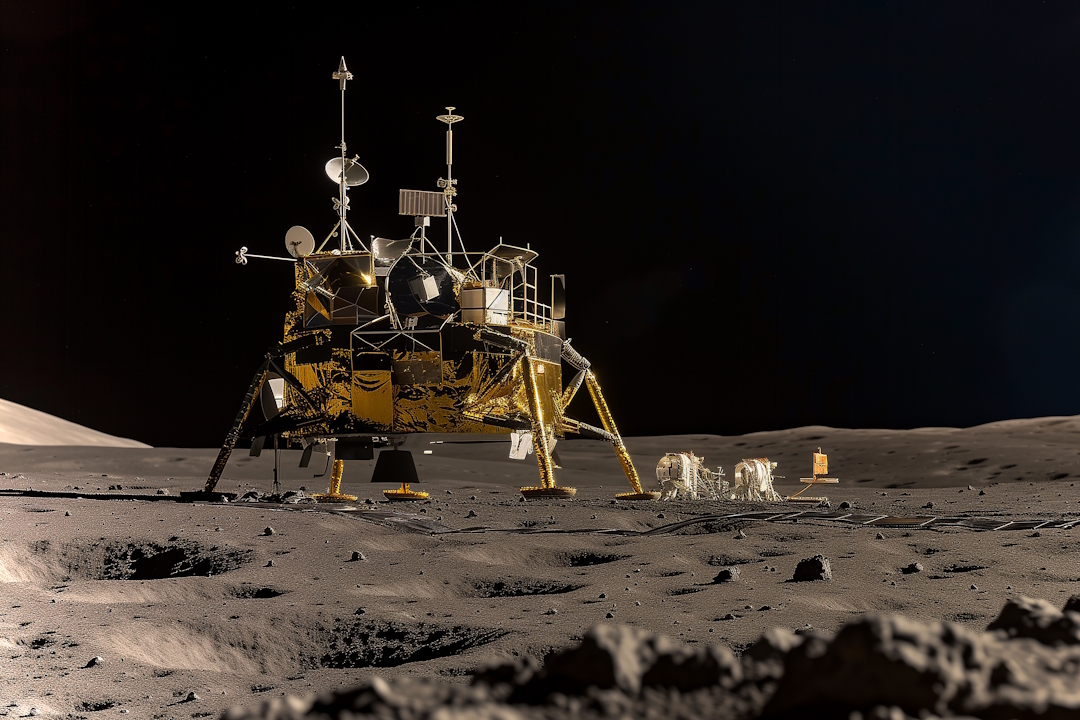
A genuinely new commercial market has emerged around lunar payload delivery services, in which private companies develop and operate lunar landers that carry scientific instruments, technology demonstrations, and commercial payloads to the lunar surface on behalf of paying customers, including government space agencies purchasing delivery services rather than owning and operating landers directly.
This shift from government-owned-and-operated lunar missions to a commercial service model mirrors the evolution that occurred earlier in low Earth orbit launch services, where commercial launch providers now serve government and commercial customers alike rather than governments building and operating their own exclusive launch capability. The lunar delivery market is at an earlier stage of this evolution, with a smaller number of missions completed and a higher failure rate than the now-mature orbital launch market, but following a broadly similar trajectory toward commercial maturity.
The economics of lunar delivery services depend on achieving sufficient mission cadence to spread fixed development costs across multiple missions and to build the operational experience that improves mission reliability over time. Companies that have achieved successful lunar landings are building a track record that supports additional government and commercial contracts, creating a competitive dynamic where early operational success compounds into further commercial opportunity.
In-Situ Resource Utilization
The ability to use resources found on the Moon, rather than transporting everything required from Earth, is the technology area with the greatest potential to transform the economics of sustained lunar activity. Water ice extraction and processing — mining ice from lunar regolith and converting it into water, oxygen, and hydrogen — is the most actively pursued in-situ resource utilization technology, given water’s fundamental importance for both life support and propellant production.
Regolith processing for construction materials represents a further extension of in-situ resource utilization, with research programs exploring methods to convert lunar soil into building materials for habitats, landing pads, and radiation shielding. The ability to construct infrastructure using lunar materials rather than transporting construction materials from Earth would dramatically reduce the cost of building permanent lunar infrastructure, given the enormous cost premium associated with launching mass to the lunar surface.
Solar power generation and storage adapted to the lunar environment — which experiences two-week periods of continuous darkness during the lunar night — represents another infrastructure technology category critical to sustained lunar operations. Companies developing power systems, including nuclear power sources designed for the lunar environment, that can provide continuous power through the lunar night are addressing a fundamental infrastructure requirement for any sustained lunar presence, whether scientific, commercial, or eventually residential.
Assessing the Lunar Economy Investment Case
Investing in lunar infrastructure requires acknowledging the substantial technical and commercial uncertainty that remains in an industry still establishing basic operational reliability. Lunar landing missions have experienced a meaningful failure rate even among well-funded, technically sophisticated programs, reflecting the genuine difficulty of the engineering challenge involved in soft landing on the lunar surface.
The companies best positioned in the current phase of lunar development are those with demonstrated technical capability, evidenced by successful missions or credible technology demonstrations, combined with a diversified customer base spanning multiple government space agencies and commercial customers rather than dependence on a single funding source. This diversification provides resilience against the funding volatility that characterizes any early-stage, government-influenced commercial market.
The lunar economy remains a longer-horizon investment theme than most other segments of the space economy discussed elsewhere, given the technical immaturity of key enabling technologies like in-situ resource utilization and the still-developing nature of the regulatory and governance frameworks for lunar resource rights. Investors drawn to this theme should size positions appropriately for a technology and market still in its formative stages, while recognizing the substantial long-term potential if the infrastructure buildout succeeds in enabling sustained commercial lunar activity.
Conclusion
The return to the Moon is fundamentally different in character from the original space race — oriented toward building durable, reusable infrastructure rather than achieving a singular demonstration of capability. The commercial lunar delivery market is genuinely new, the resource potential is scientifically credible, and the strategic interest from multiple governments is providing sustained funding and mission cadence. For investors with a long time horizon and tolerance for the technical risk inherent in an industry still establishing basic operational reliability, lunar infrastructure represents one of the more ambitious frontiers of the space economy.
Key Takeaways
- Falling launch costs and a shift to commercial lunar delivery services have created a genuinely new market that did not exist during the Apollo era.
- Water ice at the lunar poles could enable in-situ production of propellant, dramatically changing the economics of deep space missions.
- In-situ resource utilization — water extraction, regolith construction, lunar power systems — is the critical technology category for sustained lunar activity.
- Lunar infrastructure remains a longer-horizon, higher-risk investment theme given ongoing technical immaturity and mission reliability challenges.
Editorial Disclosure
This article is produced by NextGenTechStocks.com for informational and educational purposes only. NextGenTechStocks.com has not received any compensation from any company, management team, investor relations representative, or any third party in connection with the publication of this article. No staff member or principal of NextGenTechStocks.com holds a position in any security mentioned in this article at the time of publication. The information presented is based on publicly available sources and is intended to provide general market education only. Investing in technology stocks carries significant risk, including the potential loss of capital. Readers are encouraged to conduct their own due diligence and consult a qualified financial advisor before making any investment decisions. For more information, please see our full Disclaimer at NextGenTechStocks.com.