
Nauticus Robotics, Inc. (NASDAQ: KITT) announced in a press release on August 4 that it has entered a collaboration with Strangeworks, a privately held compute optimization company, to explore how artificial intelligence and quantum-inspired computing could improve the way underwater fiber-optic sensing networks are planned and deployed. The announcement is explicitly exploratory: there is no committed product, contract value, or customer named, and both companies describe the work in terms of what they intend to explore rather than what they have already built.
What DAS Actually Is
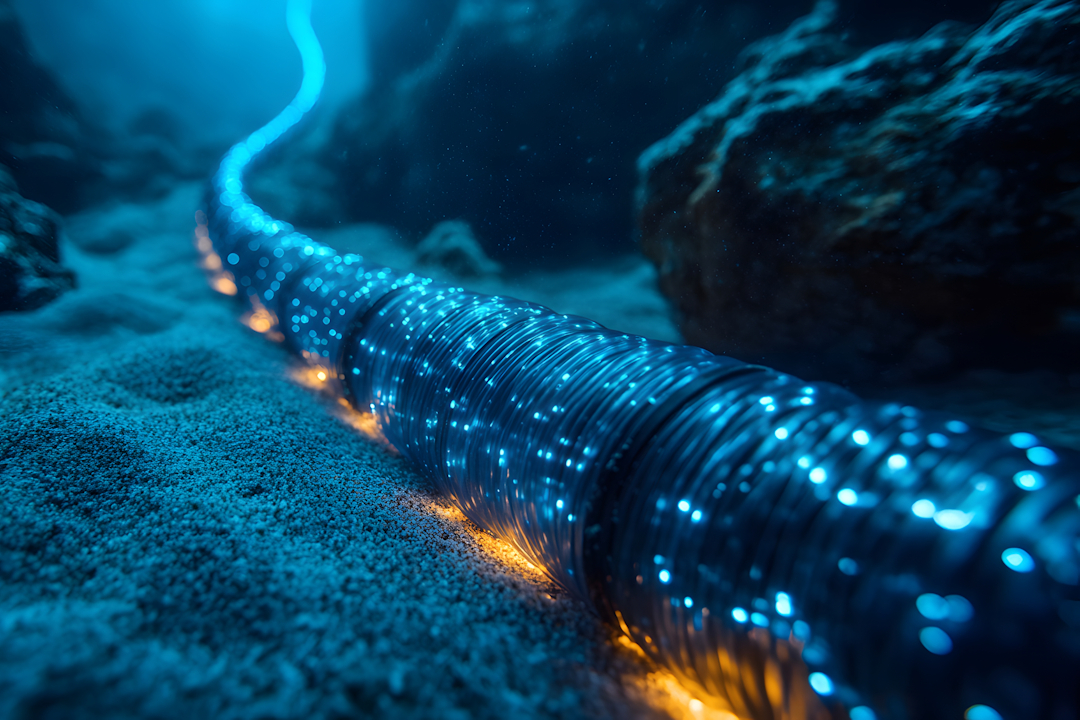
The technology at the center of this collaboration is Distributed Acoustic Sensing, or DAS, which converts an ordinary fiber-optic cable into thousands of virtual acoustic sensors along its length, without needing separate physical sensors at each point. That makes it useful for detecting activity along long stretches of seafloor, such as near ports, offshore energy infrastructure, or subsea communications cables. The release frames the core challenge as one of network design: laying the cable along the shortest possible route is not the same as laying it where it will actually detect and track activity effectively, since coverage, sensing density, and equipment needs all shift depending on the path chosen.
What Each Company Brings
Nauticus Robotics develops autonomous underwater robots and the software that controls them, including its Aquanaut platform and ToolKITT autonomy software, and is contributing operational expertise in subsea missions, the real-world constraints that make a sensing-network optimization problem meaningful in practice, such as ocean currents, equipment limitations, and mission logistics. Strangeworks contributes its Aura platform, described as applying classical optimization, artificial intelligence, quantum-inspired algorithms, and quantum computing, selecting whichever computational approach best fits a given problem rather than defaulting to one method. In plain terms, classical optimization solves a problem the way a traditional computer program would, working through possibilities in sequence; quantum-inspired algorithms borrow mathematical techniques from quantum physics to search a solution space more efficiently while still running on ordinary computers; and quantum computing, where it’s actually used, runs on specialized quantum hardware for narrow classes of problems that are especially hard for classical computers to solve.
That kind of computational triage matters for a problem like sensing-network deployment because the right approach can depend heavily on the specific conditions of a given site, water depth, seafloor terrain, the number of assets that need protecting, and how much budget exists for cable and equipment. A one-size-fits-all optimization method risks either overspending on unnecessary infrastructure or leaving coverage gaps in the areas that matter most, which is the specific inefficiency this collaboration is aimed at reducing.
What This Collaboration Is Meant to Produce
According to the release, Aura will evaluate deployment strategies for DAS networks with the goal of placing sensing capacity where it is actually needed while reducing unnecessary fiber, interrogator equipment (the hardware that reads signals back from the fiber), and overall deployment complexity. Beyond the initial deployment-planning work, both companies say the collaboration may also explore applying similar computational approaches to processing and interpreting the large volumes of data these sensing networks generate once installed, though that is described as a future possibility rather than a current work stream. A single DAS installation covering even a modest length of coastline can generate a continuous stream of acoustic data, and turning that raw signal into something a security team or infrastructure operator can actually act on is a separate technical challenge from the deployment-planning problem this collaboration is initially focused on.
Nauticus CEO John Gibson and Strangeworks CEO William Hurley both framed the collaboration in terms of potential rather than delivered results, and Nauticus VP of Autonomous Software Kjerstin Easton described it as a chance to explore where these computational techniques can improve real-world deployment challenges, language that is consistent with an early-stage technical collaboration rather than an announced product or signed customer contract.
Why This Market Matters
The release ties the collaboration to a broader trend: governments and commercial operators are expanding investment in protecting ports, subsea communications cables, offshore energy infrastructure, and other maritime assets, and the companies say they expect demand for this kind of intelligent sensing-network optimization to grow alongside that spending. That framing is the companies’ own characterization of where the market is headed, not an independently sourced market projection, and the release does not cite outside data to support it. Subsea cable protection specifically has drawn increasing public attention in recent years amid reports of damage to undersea communications and power infrastructure in various regions, which is the kind of real-world driver that would plausibly increase demand for exactly this type of sensing technology, even though this particular release doesn’t cite any of those incidents directly.
What’s Not Yet Known
This is a technology exploration agreement, not a disclosed commercial contract. The release does not include a contract value, a timeline for results, or a named customer who would actually deploy a resulting system. Whether this collaboration leads to a deployable product, a paid pilot project, or nothing at all is left open, and Nauticus’ own forward-looking statement in the release specifically flags the timing of product commercialization and customer interest in its products as uncertain.
Sources
Nauticus Robotics, Inc. and Strangeworks Collaborate on AI-Optimized Deployment of Undersea Fiber-Optic Sensing Networks, PRNewswire, August 4, 2026.
Editorial Disclosure
This article is based on a press release issued by Nauticus Robotics, Inc. on August 4, 2026, distributed via PRNewswire. Securities discussed: Nauticus Robotics, Inc. (NASDAQ: KITT). Strangeworks is a privately held company; no ticker or exchange applies to it. Next Gen Tech Stocks has not received compensation from Nauticus Robotics, Strangeworks, their management, investor relations representatives, or any third party for this coverage. No staff member or principal of Next Gen Tech Stocks holds a position in this security at the time of publication. This collaboration is described by both companies as exploratory; statements regarding future applications, product commercialization, and customer interest are forward-looking and involve risks and uncertainties, and there is no assurance this collaboration will result in a deployable product or commercial contract. References to these companies are for market context and analytical purposes only and do not constitute an investment recommendation. All securities carry investment risk including possible loss of capital. Coverage on Next Gen Tech Stocks is for informational and educational purposes only. See our full Disclaimer.