Niutech Technology Group Co., Ltd. (SSE STAR Market: 688309) said it completed a group restructuring on August 26, 2026, according to a press release dated September 30 and distributed via PRNewswire. Niutech says its registered business scope now adds resource recycling technology R&D, machinery R&D, specialized equipment manufacturing, and new materials R&D. That’s about it. There’s no detail on which entities were combined, what the terms were, or whether anything changes for shareholders.
The more useful material sits further down: a set of performance figures for the company’s continuous pyrolysis lines, all self-reported, and a single RMB 198 million order from one unnamed UK customer. Both deserve a closer look.
Heat, No Oxygen
Pyrolysis is simple in principle. Heat waste in a sealed chamber with no oxygen. Nothing burns. Instead, long polymer chains crack into smaller molecules that come out as oil, gas, and a solid char.
“Continuous” is the operative word in Niutech’s pitch. Batch reactors load, heat, cool, and empty, over and over. A continuous line keeps feeding material in and pulling product out, which is what makes industrial scale workable.
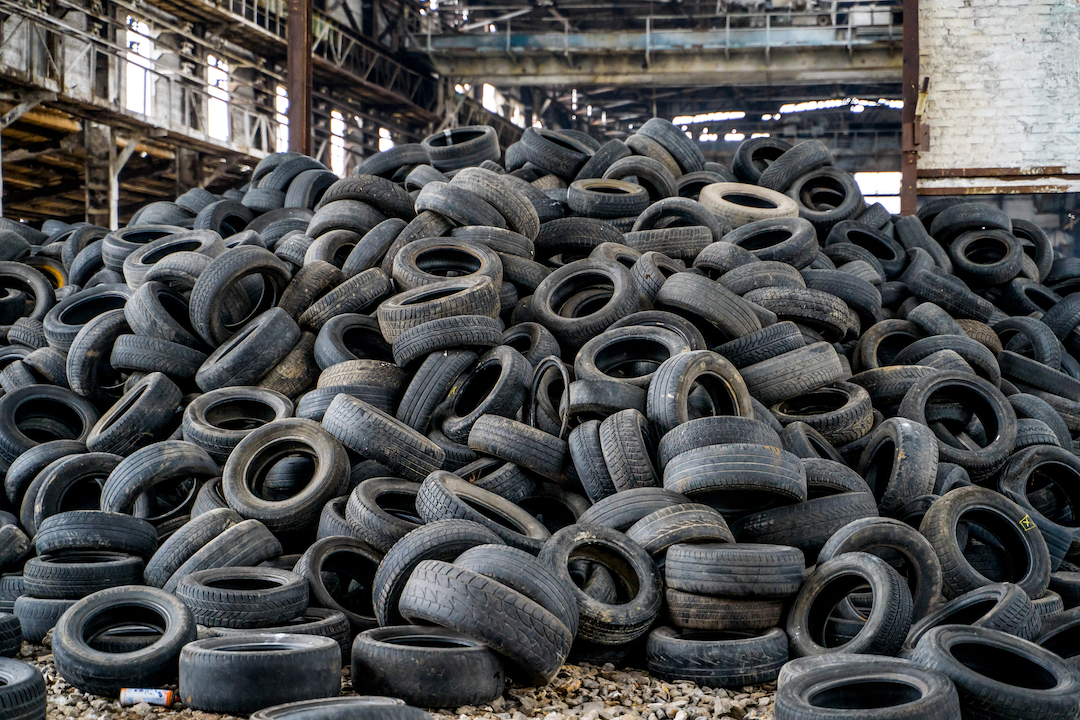
Niutech says it has worked on the process for nearly 40 years across more than 30 material streams, with tires and plastics the main two. It says it has helped customers deliver 10,000-metric-ton-scale projects in dozens of countries, including Germany, the UK, South Korea, Denmark, and Brazil. For tires, the basic output split is well documented. A 2025 life cycle study published on ScienceDirect puts typical yields at more than 40% oil by weight, up to 40% raw recovered carbon black, and around 20% gas.
The Company’s Numbers
Niutech says its newest production line handles more than 100 metric tons of feedstock per day, per unit. It also says carbon black recovered from its tire line exceeds 80% toluene transmittance.
That second figure needs translating. Toluene transmittance is a purity test defined in ASTM standard D1618. A lab mixes carbon black with the solvent toluene, then measures how much light passes through the liquid. Clearer liquid means fewer oily residues left on the carbon’s surface. Higher is cleaner. Niutech says its result qualifies the recovered carbon black to go back into tire manufacturing as raw material.
Neither number comes with a named testing lab. The release also doesn’t say whether 80% is a typical result or a best run.
On plastics, Niutech says its line skips the complex washing, sorting, drying, and fine crushing that mixed waste usually needs. Low-value municipal plastic, ocean plastic, and waste textiles go in. Pyrolysis oil, solid fuel, and combustible gas come out, according to the company, and the oil can be processed into feedstock for new plastic.
What Has Outside Backing
Some of this does have independent support. Niutech’s majority-owned subsidiary, Hesheng Environmental Protection, commissioned in 2013, holds ISCC certification. ISCC PLUS is a third-party program that certifies recycled and bio-based materials as they move through a supply chain. The claim that Hesheng was the first in its sector to earn it is Niutech’s own.
Worth knowing: ISCC PLUS relies on mass balance accounting, which allocates recycled content across the outputs of a blended process. It’s contested. The Natural Resources Defense Council has called mass balance for recycled plastics deceptive, as Packaging Digest reported in 2025.
Hesheng’s 100,000-metric-ton Phase II project is expected to lift capacity to 160,000 metric tons a year in 2026, per the release. That’s a target. The release doesn’t say the expansion is running yet.
And the UK order? One customer, unnamed, worth RMB 198 million, signed after benchmarking Niutech’s projects against global peers, the company says. No delivery schedule is given. It’s one contract, and on its own it doesn’t show broad demand.
Why Europe Is the Pitch
Niutech credits regulation with pushing demand and names three EU rules: the Packaging and Packaging Waste Regulation (PPWR), the Ecodesign for Sustainable Products Regulation (ESPR), and the End-of-Life Vehicles Regulation.
The vehicle rule checks out. The European Commission says it entered into force in August 2026 and sets recycled plastic targets for new vehicles of 15% from 2032 and 25% from 2036. ICIS, reporting on the agreed text in February, said chemical recycling can count toward those targets under mass balance accounting. That’s a genuine opening for pyrolysis suppliers. It’s also a long runway.
The Jet Fuel Thread
The release says Niutech is “accelerating work” on extending the clean tire pyrolysis oil chain and on blending pathways toward sustainable aviation fuel (SAF). That’s research language. No volumes, no dates.
It follows an August 29 announcement of a sales agreement with an unnamed “global energy major” for a waste plastic pyrolysis line rated at 10,000 to 50,000 metric tons per year, aimed at SAF feedstock. The buyer still hasn’t been identified.
The release’s only quote comes from an unnamed head of Niutech’s marketing department: “The maturity of a technology is best verified through industrial projects.” Fair enough. Most of the projects cited here, though, are described by Niutech alone.
The Bottom Line
The restructuring is corporate housekeeping, lightly explained. The technology story is more interesting: a long-running pyrolysis equipment maker with a certified Chinese plant, a sizable UK order, and a European rulebook that now rewards recycled plastic, though the real deadlines are years out.
Recovered carbon black isn’t an automatic environmental win, either. The same 2025 study found that high-quality recovered carbon black delivered net environmental savings in only two of the nine impact categories it assessed. Independent performance data from Niutech’s customers would settle a lot here.
Sources
- Niutech Completes Group Restructuring to Advance Tire and Plastic Chemical Recycling, PRNewswire, September 30, 2026.
- Niutech Signs Agreement with Global Energy Major for Waste Plastic Pyrolysis Line to Produce SAF, PRNewswire, August 29, 2026.
- New rules for a more circular European automotive sector, European Commission, August 12, 2026.
- Details of EU End-of-Life Vehicle Regulation Provisional Agreement published, ICIS, February 26, 2026.
- ASTM D1618: Standard Test Method for Carbon Black Extractables, Transmittance of Toluene Extract, ASTM International.
- Recovering carbon black from end-of-life tires: A consequential life cycle assessment, ScienceDirect, 2025.
- ISCC PLUS certification, International Sustainability and Carbon Certification.
- Mass Balance Sparks Debate in Plastic Package Recycling, Packaging Digest, March 6, 2025.
Editorial Disclosure
This article is based on a press release issued by Niutech Technology Group Co., Ltd. on September 30, 2026, distributed via PRNewswire. Securities discussed: Niutech Technology Group Co., Ltd. (SSE STAR Market: 688309). Next Gen Tech Stocks has not received compensation from Niutech, its management, investor relations representatives, or any third party for this coverage. No staff member or principal of Next Gen Tech Stocks holds a position in this security at the time of publication. Statements regarding the expected capacity of Hesheng Environmental Protection’s Phase II project, Niutech’s sustainable aviation fuel work, and future demand tied to EU regulation are forward-looking and subject to change; actual results may differ materially. Equipment performance figures and the UK order value cited in this article are company-reported and have not been independently verified. Niutech’s shares trade on the Shanghai Stock Exchange STAR Market in China, and access, currency, and regulatory conditions for non-Chinese investors may differ from those of U.S.-listed securities. References to this company are for market context and analytical purposes only and do not constitute an investment recommendation. All securities carry investment risk including possible loss of capital.
Coverage on Next Gen Tech Stocks is for informational and educational purposes only and does not constitute professional financial advice. For further details on our publishing standards, advertising relationships, and risk disclaimers, please see our full Terms & Disclaimers Page