Green Science Alliance, a privately held Japanese materials company, said in a September 28 press release that a conductive carbon rubber sheet has lifted the performance of its experimental water-based aluminum-ion battery. Starting capacity came in at 210 mAh/g or higher, about twice what an earlier version of the cell delivered. That result comes from lab cells built and tested by the company’s CEO and lead inventor, Dr. Ryohei Mori. It covers 25 charge cycles at a very slow rate, and nobody outside the company has published or reproduced it yet.
Early science, then. Still worth a look, because the fix is simple and the problem it targets is real.
Why Aluminum, and Why Water
Lithium-ion batteries run nearly everything today. They’re also flammable, and they lean on lithium, cobalt and nickel supply chains. Aluminum is cheap, stable in air and one of the most common metals in Earth’s crust. The company puts the theoretical energy density of an aluminum-ion battery near 1,060 Wh/kg, against 300 to 400 Wh/kg for lithium-ion. Those are theoretical ceilings. Real cells land well below them.
Most aluminum battery research uses ionic-liquid electrolytes built on aluminum chloride. They work, but they’re corrosive and react with moisture in the air. Cells have to be assembled in sealed nitrogen or argon environments. The current collector, the conductive backing that moves electrons in and out of an electrode, often has to be made from costly corrosion-resistant metals like molybdenum, niobium or tantalum.
A water-based, or aqueous, electrolyte sidesteps most of that. Cells can be built in open air. The electrolyte won’t burn. The pricey metals aren’t needed. The catch is water itself: above about 1.23 volts it starts splitting into hydrogen and oxygen, which caps the voltage an aqueous cell can use.
What Changed in the Lab
Mori laid out the company’s aqueous aluminum work in a 2025 review paper in Energy Advances, a peer-reviewed journal from the Royal Society of Chemistry. Back then, the cells started at roughly 103 mAh/g (milliamp-hours per gram, a measure of how much charge each gram of electrode material holds) and lost capacity quickly as they cycled.
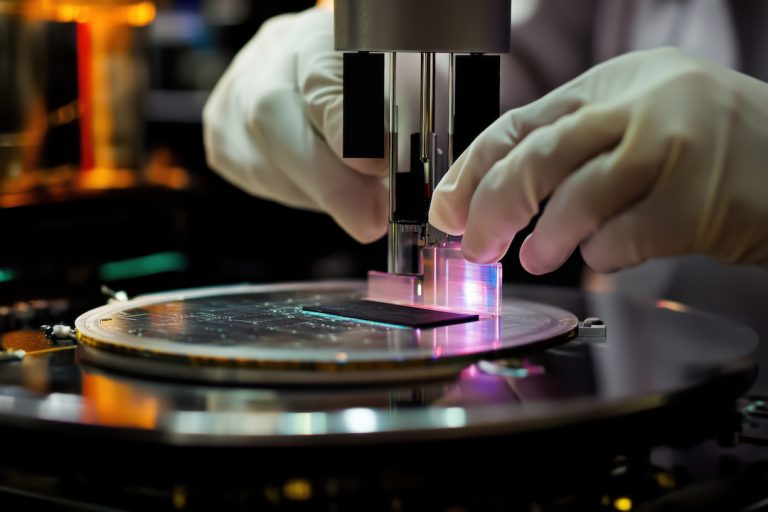
The new version swaps the current collector at the cathode, the battery’s positive side, for an off-the-shelf conductive carbon rubber sheet. Tested at room temperature and a 0.025C charge rate, the cell reached an initial capacity of at least 210 mAh/g and held it for at least 25 cycles. The company says testing is ongoing. In cyclic voltammetry, a test that sweeps voltage to show whether charge and discharge reactions are still happening, reaction peaks were still visible after 100 cycles, with the scan kept under the 1.23-volt line.
The rest of the cell is deliberately cheap: a graphite cathode, ordinary paper as the separator, a concentrated aluminum perchlorate electrolyte, and an aluminum anode with a special composition the company doesn’t disclose but says is inexpensive.
Why would rubber help? Mori’s explanation is a hypothesis, not a demonstrated mechanism. He thinks the sheet’s pores let the graphite sink in and form a 3D structure, that carbon in the sheet acts as extra cathode material, and that electrolyte soaks deeper in to create more reaction surface. His main supporting evidence: a dense carbon plate, tried in the same role, performed poorly.
Reading the Numbers Carefully
The charge rate is very slow. At 0.025C, one full charge or discharge takes around 40 hours. Slow rates tend to flatter capacity figures, and real batteries cycle much faster.
Twenty-five cycles is a small sample. Commercial stationary-storage cells are typically rated for thousands.
Cell voltage sits at 0.9 to 1.0 volts, compared with roughly 3.2 to 3.7 volts for common lithium-ion chemistries. The company says wiring cells in series solves that. It does, but more cells means more packaging and more cost per unit of stored energy.
The release also doesn’t say whether the mAh/g figure is measured per gram of graphite or per gram of the whole cathode, or whether the earlier 103 mAh/g cell was tested under the same conditions.
Then there’s validation. The 2025 review went through published peer review. The rubber-sheet result hasn’t. Part of it is slated for the 250th Meeting of The Electrochemical Society in Calgary, which runs October 25 to 29. Conference talks get far less scrutiny than journal papers.
The Cost Claim Meets a Moving Target
The release says lithium-ion costs about $115 per kWh, projects $55 to $60 per kWh for aluminum-ion batteries at scale, and suggests the company’s aqueous design could come in below $55. It doesn’t source either number.
The $115 figure matches BloombergNEF’s 2024 average pack price. BNEF’s December 2025 survey cut that to $108 per kWh. In stationary storage, the segment where a low-voltage aqueous battery would most plausibly compete, average pack prices fell to $70, and the cheapest packs BNEF observed hit $50. The benchmark has already moved. GSA’s figure is a projection for a product that doesn’t exist at scale, and cheap raw materials don’t guarantee cheap storage while voltage and cycle life stay low.
Who’s Behind It
Mori has described Green Science Alliance as an internal startup within Fuji Pigment Co., Ltd., a Japanese color chemical company he also runs. GSA has no ticker. In a 2025 interview, Mori said he hopes to raise outside capital and eventually take the company public, naming Tokyo, Switzerland or the Nasdaq. For now, retail investors have no way in.
GSA’s press releases range widely. Its PRNewswire feed includes a recent one for plant-based gel nail polish. That reads more like a broad R&D shop than a battery maker.
What to Watch
The ECS presentation in late October is the next checkpoint. Then the questions get plain. Does cycle life climb into the hundreds or thousands at practical charge rates? Does the work land in a peer-reviewed journal? Does anyone outside GSA reproduce it? Mori says he’ll keep pushing capacity and cycle stability toward industrial use. The release gives no timeline. Don’t assume one.
Sources
- Green Science Alliance Developed Stable Rechargeable Aqueous Aluminum Ion Battery with Conductive Carbon Rubber Sheet as Cathode Current Collector, PRNewswire, September 28, 2026.
- Aqueous rechargeable aluminum battery – a mini review, Ryohei Mori, Energy Advances (Royal Society of Chemistry), 2025, 4, 1321-1336.
- Lithium-Ion Battery Pack Prices Fall to $108 Per Kilowatt-Hour, Despite Rising Metal Prices, BloombergNEF, December 9, 2025.
- New Record Lows for Battery Prices, BloombergNEF, December 2025.
- Li-ion battery pack prices fell 8% since last year despite metals prices rising, BloombergNEF says, Energy-Storage.News, December 10, 2025.
- 250th ECS Meeting, The Electrochemical Society.
- Dr. Ryohei Mori: Championing Carbon-Neutral Science for a Better Tomorrow, The Corporate World (interview), July 2025.
Editorial Disclosure
This article is based on a press release issued by Green Science Alliance Co., Ltd. on September 28, 2026, distributed via PRNewswire. Securities discussed: None. Green Science Alliance is privately held and has no publicly traded securities. Next Gen Tech Stocks has not received compensation from Green Science Alliance, its management, investor relations representatives, or any third party for this coverage. No staff member or principal of Next Gen Tech Stocks holds a financial interest in the company at the time of publication. Statements regarding future battery capacity, cycle life, manufacturing cost, cost per kilowatt-hour, and industrial applications are forward-looking and involve risks and uncertainties; actual results may differ materially. The laboratory results described in this article are company-reported and have not been independently verified or published in a peer-reviewed journal. References to this company are for market context and analytical purposes only and do not constitute an investment recommendation.
Coverage on Next Gen Tech Stocks is for informational and educational purposes only and does not constitute professional financial advice. For further details on our publishing standards, advertising relationships, and risk disclaimers, please see our full Terms & Disclaimers Page