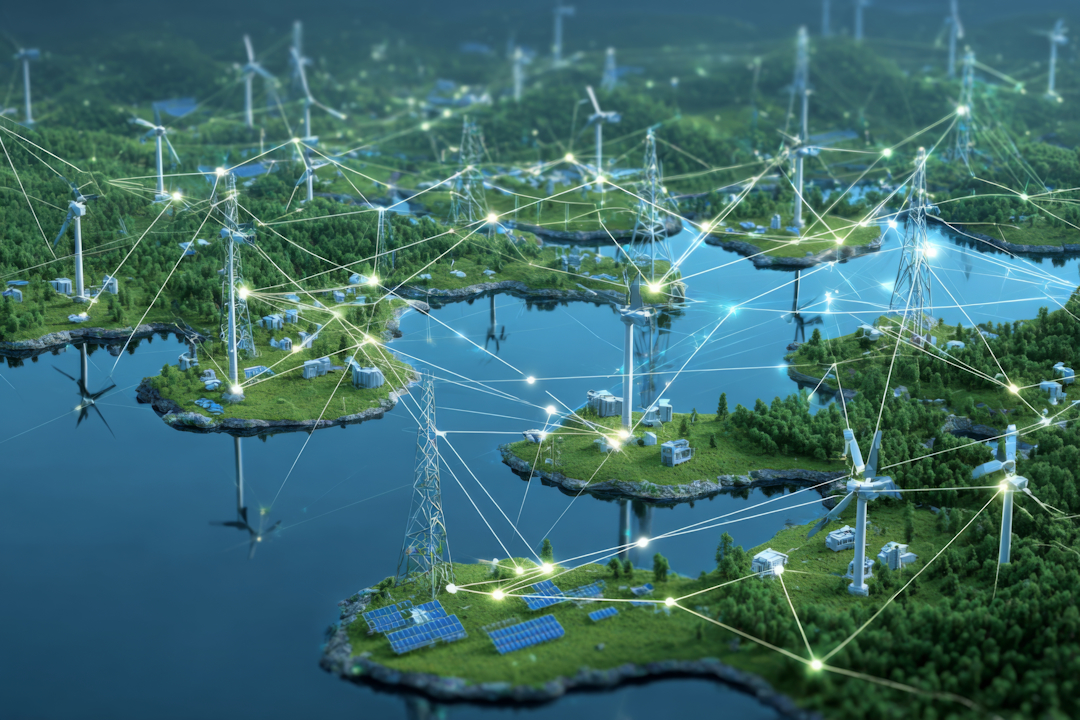
The electricity grid is one of the largest and most complex machines humanity has ever built. It was designed in the twentieth century to move power in one direction — from large, centralized power plants to passive consumers. The energy transition is breaking this model. Millions of solar panels, batteries, electric vehicles, and controllable loads are turning the grid into a bidirectional, dynamic system that requires a fundamentally different approach to management. The infrastructure being built to handle this complexity is the smart grid, and it represents one of the largest infrastructure investment opportunities of the current era.
Why the Old Grid Cannot Handle the New Energy Mix
The conventional electricity grid was designed around a fundamental principle: generation follows load. Utility operators monitored demand in real time and instructed power plants to adjust their output to match. The plants — coal, natural gas, nuclear, and hydro — could ramp up or down within minutes or hours, providing the flexibility the system needed to stay in balance.
The penetration of variable renewable generation disrupts this model in multiple ways. Solar and wind output changes faster than conventional plants can respond — a cloud cover event can drop a region’s solar output by hundreds of megawatts in minutes. The geographic distribution of renewable generation, which is sited where the resource is best rather than where the existing grid has capacity, creates transmission congestion that conventional grid management cannot resolve without curtailing renewable output. And the growing number of devices that both consume and produce electricity — homes with solar panels and batteries, electric vehicles that can charge and discharge — creates a control complexity that existing grid management systems were not designed to handle.
Addressing these challenges requires upgrades across the entire grid technology stack: advanced sensors and monitoring systems that give grid operators real-time visibility into conditions across the network, grid management software capable of optimizing across thousands of variables simultaneously, upgraded transmission infrastructure that can move power from where it is generated to where it is needed, and new business models that can coordinate the behavior of distributed energy resources to provide grid services.
Advanced Metering and Grid Visibility
The foundational enabler of the smart grid is the advanced metering infrastructure that replaces conventional electricity meters with smart meters capable of two-way communication, interval recording of consumption, and remote disconnection. Smart meters provide utilities with real-time visibility into consumption patterns at the customer level — data that enables demand forecasting, outage detection, and the time-of-use pricing signals that can shift consumption away from peak demand periods.
Beyond the meter, the distribution grid — the lower-voltage network that delivers electricity to homes and businesses — is being upgraded with sensors, automated switching equipment, and communication infrastructure that gives grid operators visibility and control capability they did not previously have. The ability to remotely reconfigure the distribution network in response to faults or generation changes reduces the frequency and duration of power outages and enables the integration of distributed energy resources.
Grid analytics software that processes the data stream from advanced metering and distribution sensors is one of the fastest-growing segments of the smart grid market. Machine learning systems that can predict grid conditions, identify equipment at risk of failure before it fails, and optimize switching and dispatch decisions in real time are creating measurable operational and reliability improvements for utilities deploying them.
Transmission: The Long-Distance Challenge
Transmission infrastructure — the high-voltage lines that move large quantities of electricity across hundreds of miles — is the segment of the grid where the gap between current capacity and future need is most acute. The geographic distribution of the best renewable energy resources does not match the geographic distribution of electricity demand. Moving solar power from the desert Southwest to demand centers in the Midwest, or offshore wind power from the Atlantic coast to inland cities, requires transmission infrastructure that does not currently exist at the required scale.
Transmission development in the United States and Europe has been chronically under-invested for decades, constrained by a permitting process that can take a decade or more from planning to energization and by the challenge of allocating costs across the multiple beneficiaries of new transmission lines. Policy reforms aimed at accelerating transmission permitting and cost allocation are underway in several major markets, creating the potential for accelerated investment that would benefit transmission equipment manufacturers, engineering firms, and grid operators.
High-voltage direct current transmission technology offers advantages over conventional alternating current for long-distance transmission, particularly for subsea cables and for connections across regions with incompatible grid frequencies. The technology is mature and commercially deployed, but the market for it is growing as renewable integration creates demand for long-distance power transfer that HVDC is better suited to serve than conventional AC transmission.
The Distributed Energy Resource Management Challenge
The millions of solar panels, batteries, electric vehicle chargers, and smart appliances connected to the grid are collectively known as distributed energy resources. Individually, each is a small contributor to grid supply or demand. Collectively, they represent a significant portion of the grid’s total capacity — and a management challenge of corresponding scale.
Distributed energy resource management systems — software platforms that aggregate and coordinate the behavior of distributed energy resources — are one of the most rapidly growing categories in the smart grid market. By treating distributed resources as a coordinated virtual power plant, utilities and grid operators can use them to provide balancing services that previously required dedicated peaking generation. The economics of coordinated distributed resources are often more attractive than building new generation capacity for the same purpose.
The investment opportunity in grid software — spanning distributed energy resource management, grid analytics, demand response, and utility operating software — is substantial and growing. These businesses exhibit software characteristics that are more attractive than the infrastructure layer: recurring subscription revenue, high switching costs from deep utility system integration, and scalability that allows revenue to grow without proportional increases in cost. For technology investors looking for exposure to the energy transition without the capital intensity of infrastructure, grid software is a compelling category.
Conclusion
The smart grid is not a single product or a single investment — it is a multi-decade infrastructure modernization that touches every component of the electricity system. The companies supplying the hardware, software, and services required to build it are positioned in front of one of the largest and most durable capital investment programs in the energy industry. For investors, the diversity of opportunity — from the infrastructure capital of transmission to the software characteristics of grid analytics — allows positioning across a range of risk and return profiles.
Key Takeaways
- The conventional grid was designed for one-directional power flow; the smart grid manages bidirectional, distributed, variable generation.
- Advanced metering infrastructure and distribution sensors provide the real-time grid visibility that modern management requires.
- Transmission infrastructure is chronically under-invested; policy reforms and renewable integration are driving accelerated investment.
- Grid software — analytics, DERMS, demand response — offers software business characteristics in an infrastructure growth market.
Editorial Disclosure
This article is produced by NextGenTechStocks.com for informational and educational purposes only. NextGenTechStocks.com has not received any compensation from any company, management team, investor relations representative, or any third party in connection with the publication of this article. No staff member or principal of NextGenTechStocks.com holds a position in any security mentioned in this article at the time of publication. The information presented is based on publicly available sources and is intended to provide general market education only. Investing in technology stocks carries significant risk, including the potential loss of capital. Readers are encouraged to conduct their own due diligence and consult a qualified financial advisor before making any investment decisions. For more information, please see our full Disclaimer at NextGenTechStocks.com.