Seattle startup Endurance Energy said on October 19 that it drilled what it calls the world’s first subsea geothermal well and ran a small power plant on an active underwater volcano nearly a mile below the Pacific. The plant produced more electricity than it used. For 8.7 seconds. And that net-positive run came from a nearby natural hydrothermal vent, not the well Endurance drilled.
Read that way, the release is less a power-plant debut than a proof-of-concept log. It’s still a meaningful one. Endurance is privately held, with no public ticker, and calls the deployment, named Adélie, a test article rather than a commercial system. What it showed is that each link in the chain worked at least once at roughly 5,000 feet: drilling, landing the plant, remote control from shore, and generation.
What the Company Says Happened
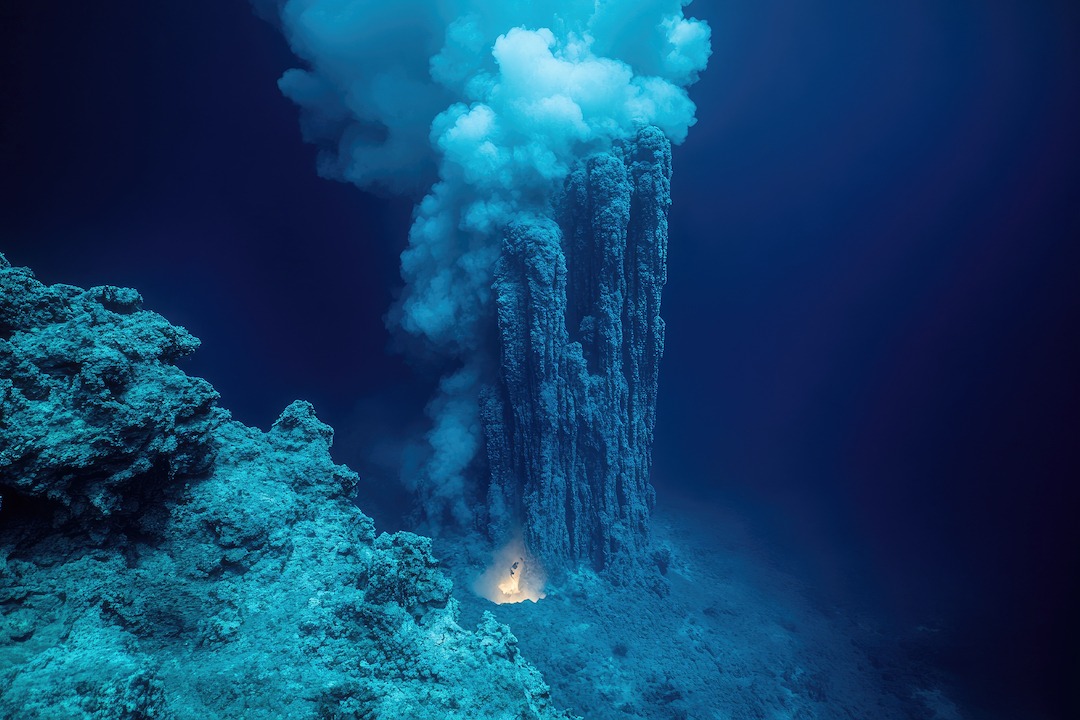
The three-week deployment took place at Axial Seamount, an active volcano about 300 miles off the Oregon coast. Inside its caldera, Endurance’s lander drill bored two holes less than two feet apart. Both hit hydrothermal fluid. The team cased and cemented the second, capped it with a valve, and finished a 52-foot (16-meter) well. After cementing, it flowed at 260°C (500°F), according to the company.
The 3-ton plant was then landed on target and run in real time from Seattle. Hooked to a natural vent at roughly 281°C (538°F), its turbine spun to about 26,000 rpm. Net output had a median of about 2 kilowatts and a peak of 16.5 kilowatts.
Some scale helps here. IEEE Spectrum, reporting on the deployment in September, described Adélie as a 100-kilowatt system. A 2-kilowatt median net is about 2% of that, held for under ten seconds.
What Broke
Endurance didn’t bury the failures. The new well delivered hot fluid but was too restrictive to run the plant, which is why the team switched to the vent. The net-positive run ended when battery overcurrent protection shut the system down. About ten minutes later, during a restart attempt, a power cable feeding the refrigerant pump failed. That ended the dive.
CEO Andrew Redd reached for a historical comparison. Robert Goddard’s first liquid-fueled rocket flew for two and a half seconds, he noted, and Adélie’s net-positive run lasted about nine. “Our approach is to make it exist, then make it good,” he said.
How Subsea Geothermal Is Supposed to Work
Geothermal power turns underground heat into electricity. Conventional plants drill into reservoirs of hot water or steam, bring that fluid up, and use its heat to spin a turbine. Endurance wants to do the same thing on the ocean floor along mid-ocean ridges, where volcanic heat sits close to the seabed.
Adélie uses what’s known as an organic Rankine cycle, IEEE Spectrum reported. Hot vent fluid warms a separate working fluid with a low boiling point inside a closed loop. That fluid turns to vapor, drives the turbine, cools, and goes around again.
The well itself is tiny. Endurance says its bore is about two inches wide, compared with the 20- to 36-inch casings that oil, gas and onshore geothermal wells often start with. The team drilled with filtered seawater instead of drilling mud.
Remote control ran over the National Science Foundation’s Regional Cabled Array, a seafloor fiber-optic network operated by the University of Washington under the Ocean Observatories Initiative. According to the university, the array has streamed real-time data to shore since 2014, with one branch running roughly 480 kilometers west to Axial Seamount. That existing link was part of why Endurance picked the site, IEEE Spectrum reported.
Environmental Claims, Lab Results Pending
Endurance says it ran a voluntary monitoring program throughout. It mapped the seafloor before placing gear, sampled water before and after each operation, and filmed the surrounding tubeworms, snails, crabs and bacterial mats on every dive. It cross-checked its findings against 11 instruments operated by outside scientists.
The company reports no unusual seismic or volcanic activity, no significant change to the seafloor community, and no significant change to the site’s natural venting. Those conclusions are Endurance’s own. More than 40 water, rock and mineral samples are now with independent laboratories, and those results haven’t been published.
The Skeptic’s Case
Geothermal is a small slice of the U.S. power mix. The U.S. Energy Information Administration has long put it at around 0.4% of national generation, and nearly every other geothermal developer works on dry land, IEEE Spectrum noted.
That’s the core doubt. Roland Horne, who directs Stanford’s geothermal program, told IEEE Spectrum that subsea geothermal is “a slightly dingbat idea, at least for grid generation,” though he saw potential for island power. He also pointed out that plenty of onshore resources remain untapped. Trade outlet ThinkGeoEnergy has flagged a related pressure point: the cost of moving power from the seafloor to shore. Endurance told IEEE Spectrum those cable costs are still being worked out.
What Comes Next
This winter, Endurance says it will deploy Gentoo, a refurbished and upgraded Adélie aimed at higher power and longer runs. Its current lander drill can reach 80 meters (about 260 feet), and the company expects deeper wells to deliver the flow needed for sustained generation. It is also developing Leopard, a 2-megawatt commercial generator.
The first commercial target is Tonga. Endurance says a project there is in development, targeting first power in 2027. Earlier this year, it signed an agreement with Tonga’s government to explore subsea geothermal resources in the kingdom’s waters, ThinkGeoEnergy reported. The need is real. Tonga’s Department of Energy said renewables supplied 27% of the country’s power as of December 2023, Matangi Tonga reported, against national targets of 70% by 2030 and 100% by 2035.
Endurance says it has raised $63 million to date, including a $54 million Series A led by Founders Fund and announced in June.
The Bottom Line
Adélie showed the pieces can work a mile down. It didn’t show they can run for long, at scale, or at a price island grids can afford. Gentoo is the next real test.
Sources
- Endurance Energy Drills World’s First Subsea Geothermal Well and Runs First Net-Positive Power Plant, PRNewswire, October 19, 2026.
- Startup Tests Offshore Geothermal Power, Julia Tilton, IEEE Spectrum, September 24, 2026 (updated September 28, 2026).
- Endurance Energy completes $54 million funding round to develop subsea geothermal technology, Carlo Cariaga, ThinkGeoEnergy, June 15, 2026.
- Regional Cabled Array, University of Washington Interactive Oceans.
- Geothermal resources used to produce renewable electricity in western states, U.S. Energy Information Administration, Today in Energy.
- Tonga reaches 27% renewable energy usage, Matangi Tonga, January 31, 2024.
Editorial Disclosure
This article is based on a press release issued by Endurance Energy on October 19, 2026, distributed via PRNewswire. Endurance Energy is a privately held company; no publicly traded securities are discussed. Next Gen Tech Stocks has not received compensation from Endurance Energy, its management, investors, communications representatives, or any third party for this coverage. No staff member or principal of Next Gen Tech Stocks holds an ownership interest in Endurance Energy at the time of publication. Technical performance and environmental monitoring figures are as reported by the company and have not been independently verified; laboratory results from the deployment have not been published. Statements regarding the Gentoo deployment, deeper wells, the Leopard generator, the Tonga project, and first power in 2027 are forward-looking and involve risks and uncertainties; actual results may differ materially. References to this company are for market context and analytical purposes only and do not constitute an investment recommendation. This is not investment advice.
Coverage on Next Gen Tech Stocks is for informational and educational purposes only and does not constitute professional financial advice. For further details on our publishing standards, advertising relationships, and risk disclaimers, please see our full Terms & Disclaimers Page