
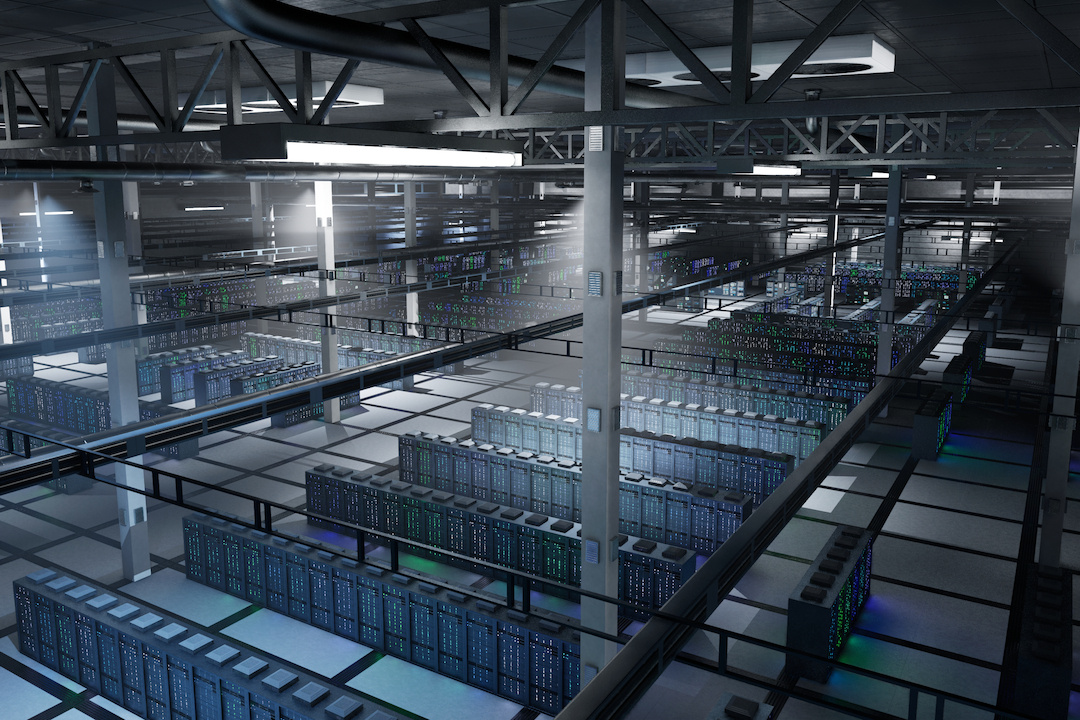
AMD (NASDAQ: AMD), Cisco (NASDAQ: CSCO), and HUMAIN, a Saudi Arabian AI company owned by the country’s Public Investment Fund, announced in a press release on August 31 that AI infrastructure built on AMD Instinct MI355X GPUs and Cisco networking hardware is now live in production, serving HUMAIN customers in Saudi Arabia and beyond. That distinction matters: this is a step past the companies’ previously announced joint venture actually delivering working, revenue-generating infrastructure, not just another plan or funding commitment.
What’s Actually Running Now
The deployment combines AMD Instinct MI355X GPUs and AMD EPYC CPUs with a networking fabric built on Cisco Silicon One and Cisco 800G optics, running through Cisco’s N9000 Series switching platform. According to the release, this interconnect is designed for large-scale AI workloads specifically, prioritizing low latency and operational resilience so HUMAIN can offer GPU-as-a-service for both training new AI models and running inference on already-trained ones. GPU-as-a-service means customers rent access to this compute capacity on demand rather than buying and operating their own GPU hardware, similar in concept to how cloud computing let companies rent server capacity instead of running their own data centers. The release confirms this infrastructure is live and serving customers today, but it does not disclose the specific capacity, in gigawatts or number of GPUs, of this initial production deployment, only the scale targets for future phases.
Why the Networking Half of This Story Matters
Cisco’s contribution here is not a minor supporting role. Training large AI models means splitting work across many GPUs that constantly need to exchange data, and if the network connecting them can’t keep pace, expensive GPU hardware sits idle waiting on data rather than computing, no matter how powerful each individual chip is. Cisco Silicon One is the company’s custom networking chip technology, and 800G optics refers to fiber connections capable of carrying 800 gigabits of data per second, both aimed at keeping that inter-GPU communication fast enough that the network isn’t the limiting factor on how quickly a cluster this size can actually train or run AI models. This is a pattern showing up across large AI infrastructure buildouts generally: raw GPU count gets most of the public attention, but the networking layer connecting those GPUs together is frequently what actually determines real-world performance at scale.
The Scale-Up Roadmap, and Why It’s Still a Forecast
The companies say the next phase, planned to begin deployment in 2027 with capacity coming online in the second half of that year, will add up to 250 megawatts of AI infrastructure built on AMD’s next-generation Instinct MI400 Series GPUs and AMD’s ROCm open-source software stack, alongside further Cisco networking. Beyond that, the joint venture’s stated target is up to 1 gigawatt of AI infrastructure capacity by 2030, a scale that would represent a substantial multi-year buildout well beyond what’s currently live. Both AMD and Cisco attach standard safe harbor language to these figures in their own securities filings, and for good reason: a joint venture’s 2030 capacity target depends on years of continued execution, financing, and demand materializing as expected, none of which is guaranteed regardless of how confident the current announcement sounds.
What “Sovereign AI” Actually Means
The release frames this partnership around sovereign AI, giving governments, enterprises, and institutions control over where their data physically resides, how their AI models are customized, and how those systems are governed, rather than relying entirely on AI infrastructure and models built and operated in other countries. That’s a real and growing government priority worldwide, not unique to Saudi Arabia, as countries increasingly want AI infrastructure and language-specific models operating under their own regulatory and data-residency requirements rather than depending entirely on infrastructure based elsewhere, a concern that spans everything from data privacy law to concerns about long-term dependence on a small number of foreign technology providers. HUMAIN’s own positioning leans into this directly, citing development of Arabic-language large language models as part of its broader full-stack AI offering, since general-purpose AI models trained primarily on English-language data have historically performed less well on Arabic and other underrepresented languages.
What HUMAIN Actually Is
HUMAIN is wholly tied to the Saudi state: it’s a company owned by the Public Investment Fund, Saudi Arabia’s sovereign wealth fund, rather than an independently traded business, so no ticker or public market exists for it directly. Its stated scope spans data centers, cloud infrastructure, AI model development, and sector-specific AI products for both public and private sector customers, positioning it as a full-stack AI provider rather than a company focused on just one layer of the AI technology stack. The release doesn’t specify HUMAIN’s current customer count, revenue, or how many customers are actually using the newly live infrastructure beyond describing demand as “strong,” a characterization that comes from the companies themselves rather than independently reported figures.
Sources
AMD, Cisco and HUMAIN Expand Saudi Arabia’s AI Infrastructure as AMD Instinct Systems Go Live, PRNewswire, August 31, 2026.
Editorial Disclosure
This article is based on a press release issued by HUMAIN on August 31, 2026, distributed via PRNewswire. Securities discussed: Advanced Micro Devices, Inc. (NASDAQ: AMD) and Cisco Systems, Inc. (NASDAQ: CSCO). HUMAIN is owned by Saudi Arabia’s Public Investment Fund and is not independently publicly traded; no ticker applies to HUMAIN directly. Next Gen Tech Stocks has not received compensation from AMD, Cisco, HUMAIN, their management, investor relations representatives, or any third party for this coverage. No staff member or principal of Next Gen Tech Stocks holds a position in these securities at the time of publication. Statements regarding the 250-megawatt 2027 deployment phase and the 1-gigawatt 2030 target are forward-looking and involve risks and uncertainties, as both AMD’s and Cisco’s own securities filings acknowledge; actual results may differ materially. References to these companies are for market context and analytical purposes only and do not constitute an investment recommendation. All securities carry investment risk including possible loss of capital. Coverage on Next Gen Tech Stocks is for informational and educational purposes only. See our full Disclaimer.