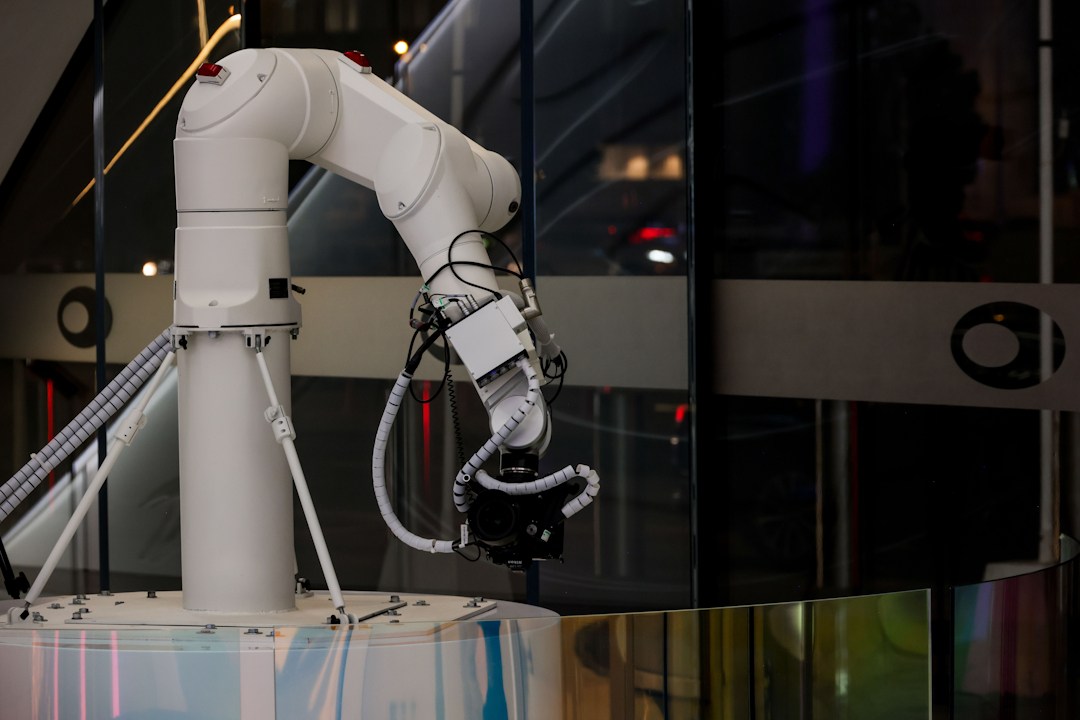
Legend Robot, a privately held construction robotics company, announced in a press release on August 25 that it previewed a regionally adapted version of its interior painting robot fleet ahead of Big 5 Construct Saudi, a construction industry trade show running August 30 through September 2 in Riyadh. The company’s 3.3-meter Putty & Latex Spraying Robot automates a specific, repetitive, and physically demanding task on construction sites: applying putty and paint finishes to interior walls, work that traditionally requires scaffolding or lifts and hours of repetitive manual spraying at height.
Where This Technology Has Already Been Used
Legend Robot cites three prior deployments to support this Saudi market entry. At DAMAC Hills in Dubai, the company says its robots performed fully autonomous vertical interior surface finishing on a high-rise building, work the company frames as reducing the safety risk of having workers spray finishes at height for extended periods, a genuine occupational hazard in high-rise interior finishing regardless of how the specific claim is verified. At DAMAC Lagoons, also in Dubai, the robots were deployed across mid-rise residential buildings, with Legend Robot describing the resulting wall coverage as “impeccable,” a characterization from the company rather than an independently verified quality assessment. At the Qiddiya entertainment megaproject near Riyadh, Legend Robot partnered with a company called Furnishing House to deploy its latex paint spraying robot for standardized interior wall finishing, which the release frames as meeting strict quality and site safety requirements without specifying what those requirements were or who set them.
The Productivity Numbers, With Context
Legend Robot reports a spraying efficiency of up to 226 square meters per hour during trial deployments at the Qiddiya mock-up site. That figure describes results from a specific trial run rather than an independently audited average across all deployments, and the release doesn’t provide a direct comparison to typical manual spraying productivity, which would be the more useful benchmark for judging how much time the robot actually saves on a real job site relative to a human crew doing the same work. The company also says its AI-driven path-planning system reduces material waste by approximately 15%, another company-reported figure without an independent source cited, and without specifying what baseline that 15% reduction is measured against, whether unassisted manual application, an earlier generation of the robot, or some other standard.
Built for Local Conditions and Supply Chains
Beyond raw productivity, Legend Robot emphasizes engineering choices aimed specifically at Gulf region conditions: thermal management systems and sealed mechanical components intended to keep the robots operating precisely even in extreme summer heat, and verified compatibility with paint and putty products already common in regional supply chains, including Jotun Durosan Interior, Jotun Fenomastic, and Jazeera Green latex coatings, along with Caparol Mid Coat and ChemiPaint Acrylic Crack Filler putty compounds. That compatibility detail matters more than it might first appear: a construction robot that only works with imported or specialty materials creates a supply chain dependency a contractor has to manage on top of adopting new equipment, while compatibility with materials already stocked by regional suppliers removes that friction and lets a contractor adopt the robot without renegotiating existing material contracts. It’s also a sign of how a hardware company approaches expanding into a new region: rather than asking customers to switch to specific proprietary materials, Legend Robot appears to have built its compatibility list around what contractors in the GCC already buy.
Why This Matters for Saudi Arabia’s Construction Pipeline
Legend Robot ties this regional push directly to Saudi Vision 2030, the country’s economic diversification plan that includes a wave of large-scale construction projects known as gigaprojects, including Qiddiya and NEOM. Large-scale construction programs on this timeline generally face genuine skilled labor constraints, since a project can only move as fast as the workforce available to execute finishing work like interior painting, which is the practical case for automating a task like this rather than simply hiring more workers, though the release doesn’t disclose specific labor shortage data tied to these particular projects. Interior finishing work in particular tends to sit on the critical path near the end of a construction schedule, meaning delays there can push back a building’s overall completion date even if every earlier phase of construction went smoothly, which is one reason a contractor might be willing to adopt new, unproven equipment for this specific task ahead of others.
What’s Not Disclosed
The release doesn’t include financial figures, a total count of robots currently deployed across all three case study sites, or an independently benchmarked comparison against either manual labor costs or competing construction robotics systems. Legend Robot has previously shown mobile spraying technology in North America and Singapore, according to the company’s past announcements, suggesting a multi-market expansion strategy, though this release focuses specifically on the Saudi and broader GCC market adaptation.
Sources
Legend Robot Unveils How Its Mobile Continuous Spraying Technology Accelerates Vision 2030 Gigaprojects at Big 5 Saudi, PRNewswire, August 25, 2026.
Editorial Disclosure
This article is based on a press release issued by Legend Robot on August 25, 2026, distributed via PRNewswire. Legend Robot is a privately held company; no securities are discussed in this article and no ticker or exchange applies. Next Gen Tech Stocks was not compensated for this coverage. Productivity figures, material waste reduction percentages, and case study outcomes described in this article originate from Legend Robot and have not been independently verified or benchmarked against manual labor or competing robotics systems. This article is for informational and educational purposes only. See our full Disclaimer.