
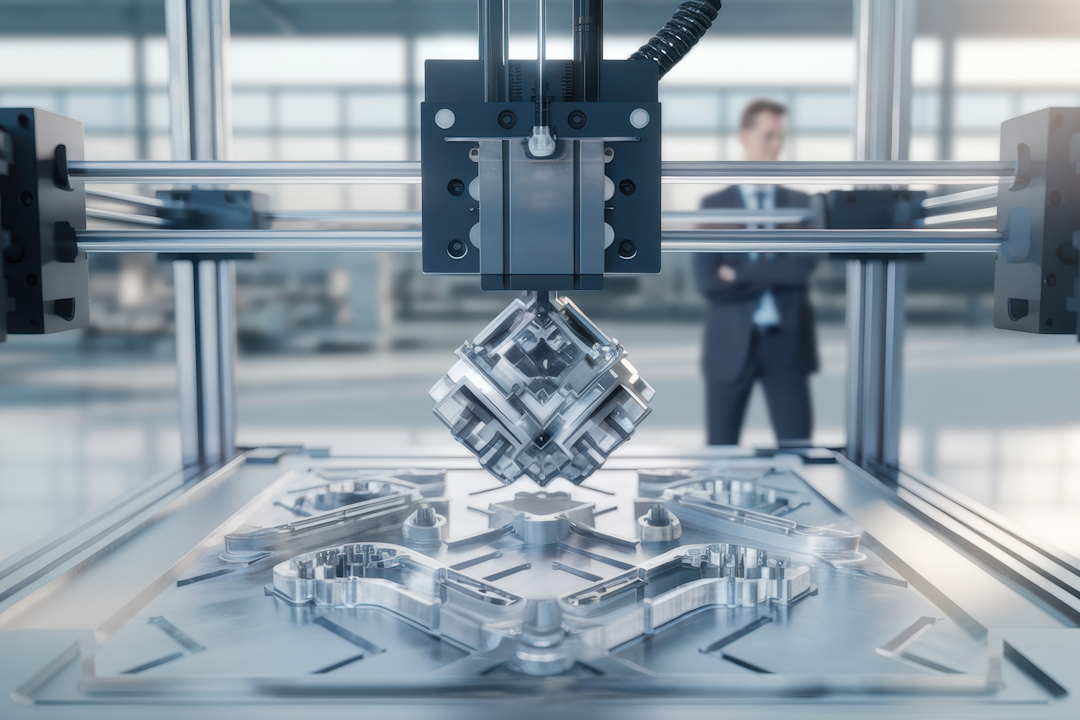
Additive manufacturing spent its first three decades as a prototyping tool — valuable for testing designs quickly but rarely used to produce final, sellable products. That has changed. Advances in materials, print speed, and quality control have pushed 3D printing into genuine production manufacturing across aerospace, medical devices, and industrial equipment. Understanding where additive manufacturing has crossed from prototyping novelty to production necessity is key to evaluating where the technology’s investment opportunity is most concrete.
From Rapid Prototyping to Production Parts
The original value proposition of 3D printing was speed: the ability to produce a physical prototype from a digital design in hours rather than the weeks required by traditional manufacturing methods like injection molding or CNC machining, which require dedicated tooling that takes time and money to produce. This prototyping application remains valuable and widely used, but it represented only a fraction of the total addressable manufacturing market.
The transition to production manufacturing required additive manufacturing technology to overcome several limitations that made early 3D printed parts unsuitable for demanding end-use applications: inconsistent material properties between prints, surface finish quality below what many applications require, production speeds too slow for meaningful manufacturing volumes, and a limited range of printable materials compared to the full range available to traditional manufacturing processes.
Progress on each of these dimensions has been substantial. Metal additive manufacturing processes now achieve material properties that meet or exceed those of traditionally manufactured parts for many applications, validated through extensive material characterization and, in aerospace and medical applications, through rigorous regulatory qualification processes. Print speeds have increased through multi-laser systems and other process innovations, and the range of qualified materials — from aerospace-grade titanium alloys to biocompatible materials for medical implants — has expanded substantially.
Where Production 3D Printing Makes Economic Sense
Additive manufacturing’s economic advantage over traditional manufacturing methods is most pronounced for parts with specific characteristics: high geometric complexity that would be difficult or impossible to produce through conventional machining or molding, low to medium production volumes where the tooling costs of traditional manufacturing cannot be amortized economically, and applications where the ability to optimize part geometry for weight reduction or performance improvement justifies a manufacturing cost premium over conventional methods.
Aerospace has emerged as the industry with the most extensive adoption of production additive manufacturing, driven by the combination of complex, weight-critical components, relatively low production volumes per part number, and an industry culture accustomed to the rigorous material and process qualification that additive manufacturing requires for flight-critical applications. Fuel nozzles, structural brackets, and heat exchangers manufactured through additive processes are now qualified and flying on commercial and military aircraft, demonstrating the technology’s readiness for the most demanding manufacturing applications.
Medical device manufacturing, particularly orthopedic implants, represents another mature production application. Additive manufacturing enables the production of implants with porous lattice structures that promote bone ingrowth, a geometric complexity that traditional manufacturing methods cannot achieve economically. The ability to customize implant geometry to individual patient anatomy, derived from medical imaging data, represents a capability unique to additive manufacturing that is driving adoption across an expanding range of orthopedic and dental applications.
The Software and Data Layer
The economic value in production additive manufacturing increasingly resides not just in the printing hardware but in the software that optimizes designs for additive processes, simulates part performance before manufacturing, and manages the quality control data required for regulated industries. Generative design software, which uses computational optimization to generate part geometries that meet specified performance requirements while minimizing material use, has proven particularly valuable for additive manufacturing, since it can produce the organic, complex geometries that additive processes can manufacture but traditional methods cannot.
In-process monitoring and quality control systems that track manufacturing parameters in real time during the printing process, detecting anomalies that could indicate defects before a part is completed, have become critical for production applications where post-manufacturing inspection alone is insufficient to guarantee part quality. This capability is particularly important for aerospace and medical applications, where the cost of a field failure is far higher than the cost of a scrapped part identified during manufacturing.
The digital thread connecting design, simulation, manufacturing parameters, and quality data for each individual manufactured part is becoming a differentiating capability for additive manufacturing companies serving regulated industries, where full traceability from design intent through final part certification is a regulatory requirement rather than merely a competitive advantage.
Investing in the Additive Manufacturing Value Chain
The additive manufacturing investment landscape spans printer manufacturers, materials suppliers, software providers, and manufacturing service companies that operate printing capacity on behalf of customers. Each segment has distinct competitive dynamics and financial characteristics that warrant separate evaluation rather than treating additive manufacturing as a monolithic investment category.
Materials suppliers, particularly those producing specialized metal powders and polymers qualified for demanding applications, often exhibit more attractive margin structures than printer hardware manufacturers, given the technical barriers to producing consistent, high-quality feedstock materials and the recurring revenue nature of materials consumption relative to the more cyclical, capital-equipment nature of printer sales.
The manufacturing services segment — companies that operate fleets of industrial 3D printers to produce parts on behalf of customers rather than selling printing equipment directly — represents a business model closer to traditional contract manufacturing, with revenue tied directly to production volume rather than equipment sales cycles. This segment has grown as more companies choose to outsource additive manufacturing production rather than investing in their own printing capacity, particularly for lower-volume or specialized applications.
Conclusion
Additive manufacturing has completed its transition from a prototyping novelty to a genuine production manufacturing technology for specific, well-suited applications. The economics remain most compelling for complex, low-to-medium volume, weight-critical components — a real but bounded segment of the total manufacturing market rather than a wholesale replacement for traditional manufacturing methods. For investors, the opportunity lies in identifying the companies across materials, software, and manufacturing services that are capturing durable value from the applications where additive manufacturing’s advantages are most economically decisive.
Key Takeaways
- Additive manufacturing has crossed from prototyping into genuine production for aerospace and medical device applications with rigorous qualification.
- Economic advantage is strongest for geometrically complex, low-to-medium volume, weight-critical parts rather than general manufacturing replacement.
- Software for generative design and in-process quality monitoring is an increasingly important, differentiated layer of value in the industry.
- Materials suppliers and manufacturing service providers often exhibit more attractive financial characteristics than printer hardware manufacturers alone.
Editorial Disclosure
This article is produced by NextGenTechStocks.com for informational and educational purposes only. NextGenTechStocks.com has not received any compensation from any company, management team, investor relations representative, or any third party in connection with the publication of this article. No staff member or principal of NextGenTechStocks.com holds a position in any security mentioned in this article at the time of publication. The information presented is based on publicly available sources and is intended to provide general market education only. Investing in technology stocks carries significant risk, including the potential loss of capital. Readers are encouraged to conduct their own due diligence and consult a qualified financial advisor before making any investment decisions. For more information, please see our full Disclaimer at NextGenTechStocks.com.