
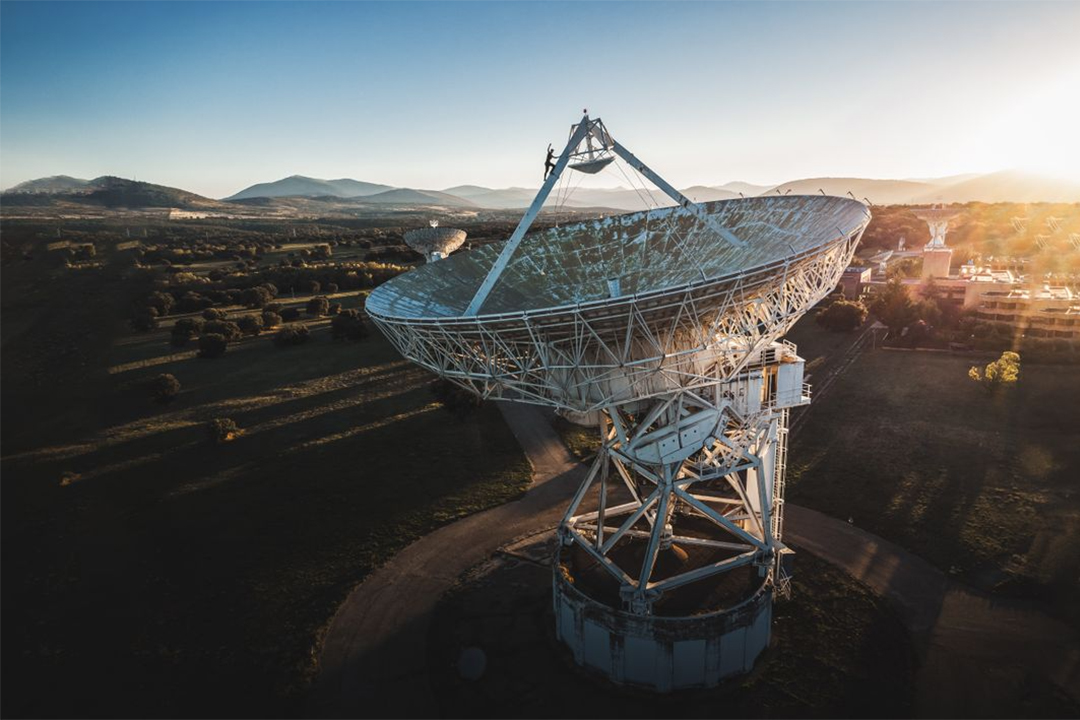
The satellite industry is in the middle of its most significant structural transformation since the first commercial communications satellites entered service in the 1960s. A new generation of low Earth orbit constellations — thousands of satellites operating in coordinated formation — is challenging the dominance of geostationary satellites, expanding broadband connectivity to populations that terrestrial infrastructure cannot reach, and enabling data services that are creating entirely new industries. For investors, this transformation represents a multi-decade opportunity with multiple entry points.
Geostationary vs Low Earth Orbit
Traditional communications satellites orbit at approximately 35,800 kilometers above the equator — the altitude at which a satellite’s orbital period matches Earth’s rotation, causing it to appear stationary from the ground. This geostationary orbit allows a small number of satellites to provide continuous coverage to large geographic areas, making it the dominant architecture for broadcast television, maritime communications, and point-to-point data links.
The physics of geostationary orbit impose a significant disadvantage for interactive applications: latency. A signal traveling from a ground station to a geostationary satellite and back covers roughly 72,000 kilometers, a round trip that takes approximately half a second even at the speed of light. This latency is imperceptible for broadcast television but severely limits the usability of geostationary satellite internet for applications like video conferencing, online gaming, and financial trading that require fast, responsive connections.
Low Earth orbit satellites operate at altitudes of 200 to 2,000 kilometers, reducing the signal round trip to tens of milliseconds — comparable to many terrestrial internet connections. The tradeoff is that low Earth orbit satellites move rapidly across the sky, so providing continuous coverage requires large constellations of many satellites working in coordination. The economics of this approach were prohibitive when launch costs were high. The cost reductions achieved by reusable launch vehicles have made large low Earth orbit constellations commercially viable for the first time.
The Broadband Connectivity Opportunity
Global broadband connectivity is profoundly unequal. Dense urban areas are served by multiple competing terrestrial providers with fiber, cable, and wireless infrastructure. Rural and remote areas often have one option or none. Island nations, maritime routes, and polar regions are systematically underserved by terrestrial infrastructure. Satellite broadband from low Earth orbit constellations is the most credible technology for reaching these populations and locations with service comparable in latency and throughput to urban fiber.
The market opportunity for satellite broadband extends beyond residential connectivity. Commercial aviation is deploying satellite internet connectivity to serve passengers on long-haul flights, creating a subscription revenue stream from tens of millions of flight hours annually. Maritime operators, offshore energy platforms, and military users represent additional market segments where satellite broadband replaces slower, more expensive legacy solutions.
Enterprise connectivity for remote operations — mining sites, agricultural facilities, construction projects, and distributed infrastructure monitoring — is another addressable market where satellite broadband competes not against fiber or cable but against the alternative of no connectivity at all. This market is characterized by high willingness to pay and limited sensitivity to the price premium that satellite connectivity currently carries over terrestrial alternatives in connected markets.
Earth Observation: Data From Above
Satellite-based earth observation has evolved from a government intelligence activity into a commercial data industry generating significant revenue from private sector customers. High-resolution optical satellites can image any point on Earth multiple times per day, producing imagery that is sold to agriculture companies monitoring crop conditions, insurance companies assessing catastrophe damage, retail analysts counting cars in parking lots, and energy companies tracking commodity flows.
Synthetic aperture radar satellites represent a complementary capability to optical imaging. Unlike optical satellites, which require daylight and cloud-free conditions, radar satellites can image through clouds and at night, providing coverage that optical satellites cannot match in persistently cloudy regions or for time-sensitive monitoring requirements. The combination of optical and radar data gives subscribers a more complete and reliable picture of the physical world than either technology alone.
The analytical layer on top of raw satellite imagery has become an increasingly important source of value in the earth observation industry. Machine learning algorithms that can automatically detect and quantify specific features — deforested areas, construction activity, vehicle counts, crop stress — transform raw imagery into structured data products that customers can integrate directly into their decision-making processes. Companies competing in earth observation data analytics are building genuinely differentiated products in ways that raw imagery providers cannot easily replicate.
Positioning and the Invisible Infrastructure
Global navigation satellite systems — GPS in the United States, Galileo in Europe, GLONASS in Russia, and BeiDou in China — are infrastructure that the global economy depends on in ways that are rarely visible to end users. Precise positioning and timing derived from these constellations underpins agricultural equipment guidance, autonomous vehicle navigation, financial transaction timestamping, power grid synchronization, and smartphone location services.
The commercial opportunity in satellite navigation has shifted from the hardware of receivers to the software and services that consume positioning data. High-precision positioning services that augment the accuracy of standard GPS signals — from centimeter accuracy for precision agriculture to sub-meter accuracy for autonomous vehicles — represent a growing market for satellite navigation companies that have moved up the value chain from hardware to data services.
Investment in the satellite navigation sector tends to be indirect for most investors, as the core navigation constellations are government-owned infrastructure. The commercial opportunity lies in the companies providing augmentation services, precision agriculture systems, autonomous navigation technology, and the chips and modules that integrate navigation capabilities into consumer and industrial devices.
Conclusion
Satellite networks are the connective tissue of the global information economy, providing communications, data, and positioning services that terrestrial infrastructure cannot match in reach or resilience. The current era of large low Earth orbit constellations and increasingly capable earth observation satellites is extending these capabilities in directions that were commercially unviable a decade ago. For investors, the satellite industry offers exposure to durable, infrastructure-like revenue streams alongside higher-growth opportunities in data analytics and connectivity services.
Key Takeaways
- Low Earth orbit constellations address geostationary latency limitations, opening new markets for satellite broadband.
- Earth observation from orbit has become a commercial data business serving agriculture, insurance, finance, and energy companies.
- The analytical layer on top of raw satellite imagery — not the imagery itself — is where the most defensible value is being built.
- Satellite navigation infrastructure underpins vast economic activity; commercial value lies in augmentation services and precision applications.
Editorial Disclosure
This article is produced by NextGenTechStocks.com for informational and educational purposes only. NextGenTechStocks.com has not received any compensation from any company, management team, investor relations representative, or any third party in connection with the publication of this article. No staff member or principal of NextGenTechStocks.com holds a position in any security mentioned in this article at the time of publication. The information presented is based on publicly available sources and is intended to provide general market education only. Investing in technology stocks carries significant risk, including the potential loss of capital. Readers are encouraged to conduct their own due diligence and consult a qualified financial advisor before making any investment decisions. For more information, please see our full Disclaimer at NextGenTechStocks.com.