
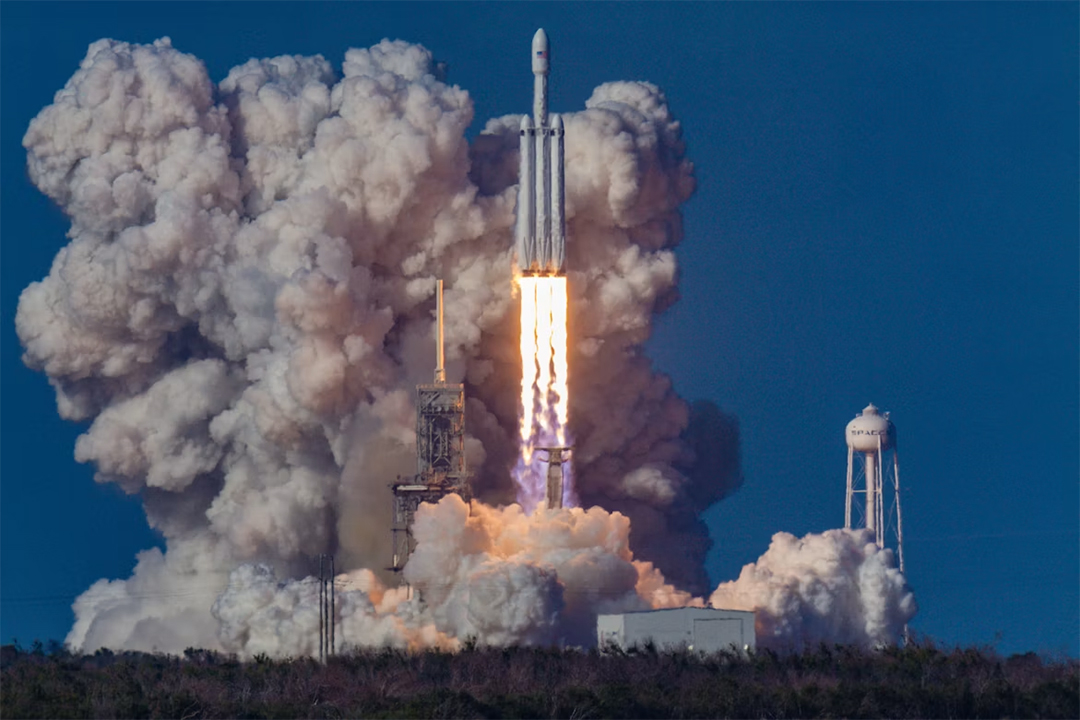
For most of the twentieth century, space was a domain of governments. The economics were simple: only nation-states could afford the infrastructure, and only national security and scientific prestige justified the expense. That calculus has changed fundamentally. The cost of reaching orbit has fallen by more than ninety percent over the past two decades, and a new generation of private aerospace companies has turned low Earth orbit into a commercial operating environment. The investment implications are significant and still underappreciated.
How the Cost Collapse Happened
The single most important development in modern aerospace is reusable rocket technology. Expendable rockets — the dominant design for decades — were used once and discarded, making each launch enormously expensive. Reusable launch vehicles recover and refurbish rocket components between missions, spreading development and manufacturing costs across many flights rather than a single one. The cost reduction this enables is comparable in scale to what standardized shipping containers did for global trade.
This cost reduction has enabled entirely new categories of space activity. Satellite constellations that would have been prohibitively expensive to deploy when each launch cost hundreds of millions of dollars became economically viable when the same payload could be delivered for a fraction of the price. The result is a proliferation of satellites in low Earth orbit serving applications from global broadband internet to precision agriculture to maritime tracking.
The falling cost of launch has also democratized access to space for a much wider range of customers. Government agencies that previously operated on launch timelines of years now share capacity with commercial satellite operators, technology companies, and research institutions. This diversification of the customer base has given launch providers a more resilient revenue mix than the purely government-dependent model of the previous era.
The Satellite Economy
The most commercially mature segment of the new space industry is satellite services. Communications satellites have been a commercial business for decades, but the current generation of low Earth orbit constellations represents a qualitative departure from the geostationary satellites that defined the previous era. Low Earth orbit satellites are physically closer to the ground, which means data travels between the satellite and the user in milliseconds rather than the half-second round-trip latency of geostationary systems. That latency difference makes a wide range of real-time applications viable from space for the first time.
Earth observation from orbit has grown from a niche capability used primarily by intelligence agencies into a commercial data business. High-resolution optical and radar imagery, captured multiple times daily over any point on the planet, is sold to agriculture companies monitoring crop health, insurance firms assessing disaster damage, and financial analysts tracking industrial activity. The economic value of this data is substantial and growing as the resolution and revisit frequency of commercial satellites continue to improve.
Positioning and navigation services derived from satellite constellations underpin a broad range of economic activity that most people never consciously associate with space. Precision agriculture, autonomous vehicle navigation, financial transaction timestamping, and mobile device location services all depend on orbital infrastructure. The invisibility of this dependency is itself a testament to how thoroughly satellite services have been integrated into the global economy.
Beyond Low Earth Orbit
The commercial ambitions of the new space industry extend well beyond the satellite economy. Lunar exploration has attracted significant private investment, driven partly by government contracts and partly by the long-term commercial potential of lunar resources. The Moon contains helium-3, a potential fuel for fusion reactors, as well as water ice that could be converted into rocket propellant — potentially enabling a refueling infrastructure that would dramatically reduce the cost of missions deeper into the solar system.
Space tourism, while still in its early commercial stages, represents the opening of an entirely new market segment. The customer base for orbital and suborbital experiences is necessarily limited by price at current cost levels, but the industry’s trajectory — falling costs, improving vehicles, expanding infrastructure — points toward a long-term expansion of the addressable market. What is a luxury experience today could become an accessible premium product within two decades, following a trajectory similar to commercial aviation in its early decades.
In-space manufacturing is another category attracting investment, premised on the unique conditions of microgravity and vacuum that cannot be replicated on Earth. Pharmaceutical companies, fiber optic manufacturers, and semiconductor researchers have all investigated processes that may be only achievable in orbit. The commercial viability of in-space manufacturing remains to be demonstrated at scale, but the scientific foundations are real.
Investing in the Space Economy
The space economy presents investors with a range of entry points, each with different risk and maturity profiles. Launch services, satellite manufacturing, and ground systems are established businesses with identifiable customers and revenue. Earth observation data analytics, satellite broadband, and navigation services represent more recently commercialized segments with strong growth trajectories. Lunar infrastructure and in-space manufacturing are earlier-stage opportunities with longer time horizons.
The investment case for established space companies rests on the structural growth of demand for satellite capacity and launch services, driven by the proliferation of low Earth orbit constellations, expanding government spending on space systems, and the growing integration of space-derived data into terrestrial industry. These drivers are durable and largely independent of the economic cycle.
The risk factors specific to space investing are worth understanding clearly. Launch failures are low-probability events with high financial consequences. Satellite constellations require continuous investment in replenishment as individual satellites age out. Regulatory environments for spectrum allocation and orbital slots are complex and subject to international negotiation. These risks are manageable with appropriate portfolio construction but should not be minimized in the analysis of individual companies.
Conclusion
The privatization of space is not a speculative narrative — it is an industrial reality with measurable economic output and expanding commercial applications. The cost reductions achieved by the current generation of launch providers have permanently altered the economics of space access, and the consequences of that shift are still propagating through adjacent industries. For investors willing to engage with its complexity, the space economy offers exposure to structural growth that spans communications, data, defense, and eventually resources.
Key Takeaways
- Reusable rocket technology has reduced launch costs by over 90%, enabling an entirely new commercial space economy.
- Satellite services — broadband, earth observation, and navigation — represent the most commercially mature segment of the sector.
- Investment opportunities span multiple maturity levels, from established launch providers to early-stage in-space manufacturing.
- Space investing carries specific risk factors — launch failures, spectrum regulation, and constellation replenishment costs — that require careful analysis.
Editorial Disclosure
This article is produced by NextGenTechStocks.com for informational and educational purposes only. NextGenTechStocks.com has not received any compensation from any company, management team, investor relations representative, or any third party in connection with the publication of this article. No staff member or principal of NextGenTechStocks.com holds a position in any security mentioned in this article at the time of publication. The information presented is based on publicly available sources and is intended to provide general market education only. Investing in technology stocks carries significant risk, including the potential loss of capital. Readers are encouraged to conduct their own due diligence and consult a qualified financial advisor before making any investment decisions. For more information, please see our full Disclaimer at NextGenTechStocks.com.