
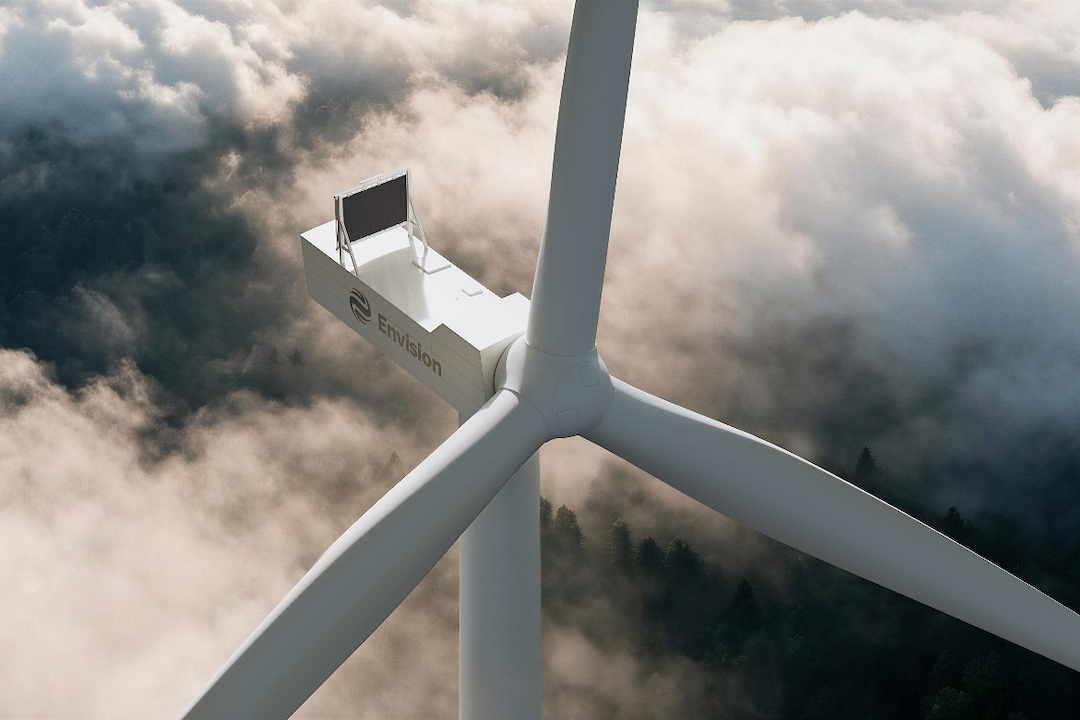
Envision Energy launched a new onshore wind turbine at WindEnergy Hamburg on September 25, according to a company press release. The Model T EN175/8.0 is rated at 8 megawatts and spins a 175-meter rotor. Envision says it can produce 2% to 12% more energy than the company’s existing models, depending on the site. That range is Envision’s own number. It compares the new machine with Envision’s older turbines, and the release doesn’t say which ones or how the gain was tested.
So why care about a turbine from a company whose shares you can’t buy? Scale. Envision is privately held, but BloombergNEF ranked it the world’s second-largest wind turbine supplier in 2025, with 20.9 gigawatts installed. Almost a quarter of that went outside mainland China. When a supplier that size shows up at Europe’s biggest wind trade fair with a new onshore machine, the listed companies it competes with, Vestas and Nordex among them, are selling into the same market.
A Bigger Rotor for Average Wind
Almost every design choice here points at one kind of site: places where the wind is steady but not strong.
Rotor size is the main lever. A 175-meter rotor sweeps a circle of roughly 24,000 square meters, about four and a half American football fields. A bigger circle catches more moving air. That matters most where the air isn’t moving very fast.
The 8 MW figure is rated capacity, the turbine’s maximum output once winds are strong enough. Most of the time a turbine runs below it.
Envision designs and builds the blades, gearboxes and generators in-house. The company argues this vertical integration helps with quality and cost control over the turbine’s life. The release offers no cost figures to back that up.
Quieter Blades, With a Caveat
Noise complaints are one of the most common reasons onshore wind projects stall. Envision says the EN175/8.0 uses its sixth-generation low-noise airfoils plus newly developed serrated trailing edges. Those are saw-tooth edges along the back of each blade. They break up the turbulence behind the familiar swoosh.
Envision says the edges were validated in wind-tunnel testing. That testing is the company’s own; no outside lab is named. The sound figure is a target, not a certified result: a sound power level of 107 dB(A), with optional quieter operating modes for noise-sensitive projects. Sound power measures noise at the source. It isn’t what a neighbor half a mile away actually hears.
For cold regions there’s an optional blade ice-prevention system with multiple heating zones, tied into the lightning protection. Envision also lists configurations for cold climates, higher extreme wind speeds and mountainous terrain.
What the AI Actually Does
This is where the marketing gets loudest. Envision calls the turbine’s Galileo control system AI-powered, running on two in-house models it has named the Tianji Weather Foundation Model and the Dubhe Energy Foundation Model.
In plain English: standard turbine controls follow preset rules for angling the blades and turning into the wind. Envision says Galileo reads real-time conditions and adjusts its own control strategy rather than relying only on those rules. What the release doesn’t say is how much of the claimed yield gain comes from software and how much from the bigger rotor. No third-party performance data is included.
The grid feature is easier to pin down. Most wind and solar plants are “grid-following,” meaning they sync to a voltage and frequency set by conventional power stations. Grid-forming equipment can help hold that voltage and frequency steady on its own. Envision says the EN175/8.0 pairs a full-power converter with grid-forming controls. It also claims fast fault ride-through, so the turbine stays connected through brief grid disturbances instead of tripping offline. As coal and gas plants retire, grid operators want more renewables that can do this.
Platform Numbers, Kept Apart
Envision says its Model T platform has more than 4,000 units ordered and around 1,500 installed. Those figures describe different stages, orders versus turbines actually standing. And they cover the whole platform, not this model.
The EN175/8.0 is brand new. The release names no customers, orders, pricing, certification or delivery dates for it.
How It Compares
Envision isn’t the first to this rotor size. Nordex already sells the N175/6.X, with the same 175-meter rotor and a rating of 6.0 to 6.X MW. Nordex lists a sound power level of 106.0 dB(A) at 6.22 MW. It also claims 7% to 14% more yield than its own earlier N163 models at typical low- to medium-wind sites.
Turbine makers usually quote yield gains against their own previous machines, so the percentages don’t compare across brands. Envision puts more generator capacity behind the same rotor diameter, and its noise target is only slightly higher. Whether that turns into more energy at a real site depends on the local wind.
The bigger story is exports. BloombergNEF found Chinese turbine makers installed 93% of their 2025 capacity at home, down from 99% in 2024. Its head of wind research said thin margins in China are pushing these suppliers abroad, where they compete on low-cost production and fast delivery. A Hamburg launch puts this turbine directly in front of European developers.
The Plant-Level Pitch
Lou Yimin, Envision’s Senior Vice President and Chief Product Officer, said the next generation of wind “is not simply about making turbines larger.” The company says it aims to coordinate wind, solar, storage and industrial power demand as one system, optimizing returns across a whole plant rather than turbine by turbine. That’s a stated goal. The release doesn’t describe a project where this turbine has done it.
The Bottom Line
Confirmed: the specs, the launch and Envision’s scale as the No. 2 supplier worldwide. Not confirmed: independent yield data, a certified noise figure, orders or a delivery timeline. Envision has no public stock. For readers, the signal is competitive. A top-two global turbine maker is bringing a large, heavily marketed onshore machine to European buyers, the same customers its listed rivals serve.
Sources
- Envision Energy Launches Model T – EN175/8.0 Onshore Wind Turbine, Advancing Plant-Wide Optimization and Lifecycle Value for Future Energy Systems, PRNewswire, September 25, 2026.
- Chinese Turbine Suppliers Seize the Spotlight as Global Wind Power Installations Hit All-Time High, BloombergNEF Report Shows, BloombergNEF, March 9, 2026.
- N175/6.X Product Page, Nordex SE.
Editorial Disclosure
This article is based on a press release issued by Envision Energy on September 25, 2026, distributed via PRNewswire. Envision Energy is a privately held company with no publicly traded shares; nothing in this article implies a retail investment opportunity in the company. Next Gen Tech Stocks has not received compensation from Envision Energy, its management, investor relations representatives, or any third party for this coverage. Statements regarding energy yield improvements, noise performance, AI-enabled optimization, grid support capabilities, and plant-level value are the company’s own characterizations and are forward-looking; they involve risks and uncertainties, and actual results may differ materially. The 2% to 12% yield range and the 107 dB(A) sound target have not been independently verified. References to other wind turbine manufacturers are for market context and analytical purposes only and do not constitute an investment recommendation. All securities carry investment risk including possible loss of capital.
Coverage on Next Gen Tech Stocks is for informational and educational purposes only and does not constitute professional financial advice. For further details on our publishing standards, advertising relationships, and risk disclaimers, please see our full Terms & Disclaimers Page