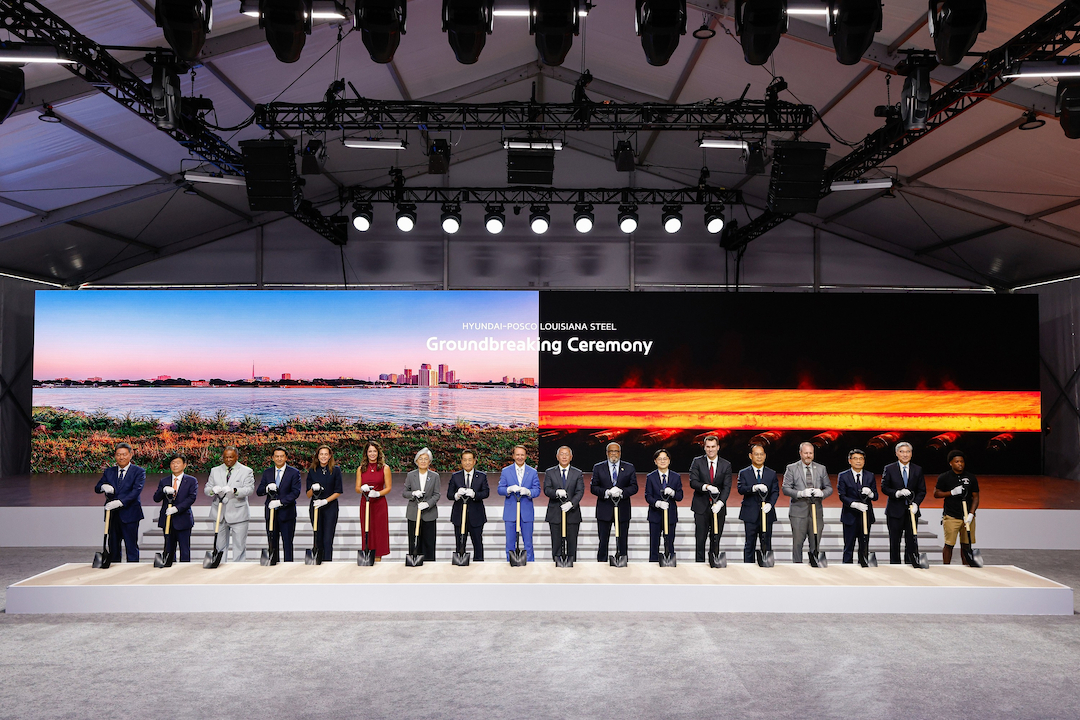
Hyundai Steel Company (KRX: 004020) held a ceremonial event on September 4 marking the launch of a $5.8 billion Electric Arc Furnace (EAF)-based integrated steel mill in Ascension Parish, Louisiana, which the company says is the first plant of its kind in North America. The mill will be operated by HYUNDAI-POSCO Louisiana Steel LLC (HPLS), a joint venture between Hyundai Steel, POSCO (KRX: 005490) (NYSE: PKX), Hyundai Motor Company, and Kia Corporation. Commercial production is targeted for 2029, with an annual capacity of 2.7 million metric tons of hot-rolled and cold-rolled steel sheets aimed primarily at automotive applications, and the project is expected to create 5,400 jobs, including 1,300 direct positions, according to the release.
Why “Electric Arc Furnace” Is the Actual Story
Most steel produced worldwide still comes from traditional blast furnaces, which convert iron ore into steel using coal or coke as both fuel and a chemical reducing agent, a process that generates substantial carbon emissions. An Electric Arc Furnace instead melts steel primarily from recycled scrap metal using electricity, which can significantly lower the carbon footprint of production, especially when paired with lower-carbon electricity sources, and also means the facility’s emissions profile is tied partly to how the electricity it draws is generated locally. Hyundai Steel says the facility will also use a Direct Reduction Process, a method that converts iron ore into metallic iron using natural gas or hydrogen rather than a traditional blast furnace, providing an additional lower-carbon iron source to feed the EAF alongside recycled scrap, useful for producing steel grades that need more virgin iron than recycled scrap alone can supply. The combination of EAF plus direct reduction is a meaningfully different production route than a conventional integrated steel mill, though the release doesn’t provide a specific quantified emissions reduction figure for this facility, so the actual carbon savings compared to a traditional mill of similar output can’t be verified from this announcement alone.
What This Is Actually For
The mill is explicitly built to supply Hyundai Motor and Kia’s North American vehicle production with steel sheets, tying a new domestic manufacturing facility directly to the automakers’ existing U.S. assembly plants rather than continuing to rely on imported steel. That kind of vertical integration, an automaker’s own corporate family producing its own steel supply domestically, reduces exposure to import tariffs, shipping costs, and international supply chain disruptions that can affect a company relying on steel sourced from overseas, though it also means Hyundai Motor Group is taking on the capital cost and operational risk of running a steel mill rather than simply purchasing steel on the open market, a meaningfully different business commitment than a typical supply contract. Automotive-grade steel sheet also has to meet tighter quality and consistency specifications than steel used in construction or general industrial applications, which is part of why an automaker might prefer controlling that supply directly rather than depending on a third-party mill to consistently hit those specifications at the volumes a major vehicle production program requires.
Part of a Much Larger Investment Commitment
This project is one piece of Hyundai Motor Group’s broader $26 billion U.S. investment commitment through 2028, announced in 2025, which the release says spans automotive production, advanced steelmaking, robotics, and other sectors as part of an effort to build a more fully integrated U.S. manufacturing and mobility supply chain. Hyundai Motor Group says it has invested more than $20.5 billion in the U.S. since entering the market in 1986, providing some historical scale context, though that cumulative figure spans four decades of investment across the group’s full range of businesses, not just steel, so it shouldn’t be read as directly comparable to the $5.8 billion figure attached to this specific project. The ceremony itself drew a notably high-profile guest list, including Louisiana’s governor, multiple U.S. representatives, South Korea’s trade minister, and the CEOs of Hyundai Motor and Kia, reflecting how both governments are treating this as a significant bilateral economic and manufacturing milestone rather than a routine corporate announcement.
What’s Still a Multi-Year Bet
A ceremonial event marking a project’s launch is not the same as a completed, operating facility. Commercial production isn’t targeted until 2029, meaning this is a multi-year construction and ramp-up process during which costs, timelines, and the broader economic conditions the plant depends on, automotive demand, steel pricing, and energy costs among them, can all shift between now and then. The release doesn’t disclose a construction completion date ahead of the 2029 commercial production target, nor does it specify how the $5.8 billion investment is split among the four joint venture partners, information that would help clarify each company’s specific financial exposure to the project’s success or delay, or what happens to the timeline if automotive demand or steel market conditions change materially before the mill reaches full operation.
Sources
Hyundai Steel Company: Hyundai Steel Celebrates Louisiana EAF Steel Mill Project Launch, Driving Growth for U.S. Manufacturing, PRNewswire, September 4, 2026. https://www.prnewswire.com/news-releases/hyundai-steel-celebrates-louisiana-eaf-steel-mill-project-launch-driving-growth-for-us-manufacturing-302870544.html
Editorial Disclosure
This article is based on a press release issued by Hyundai Steel Company on September 4, 2026, distributed via PRNewswire. Securities discussed: Hyundai Steel Company (KRX: 004020) and POSCO (KRX: 005490) (NYSE: PKX). Hyundai Motor Company (KRX: 005380) and Kia Corporation (KRX: 000270), also joint venture partners, are publicly traded on the Korea Exchange. Next Gen Tech Stocks has not received compensation from Hyundai Steel, POSCO, Hyundai Motor Company, Kia Corporation, their management, investor relations representatives, or any third party for this coverage. No staff member or principal of Next Gen Tech Stocks holds a position in these securities at the time of publication. Statements regarding commercial production timing, capacity, job creation figures, and emissions reductions are forward-looking projections tied to a project still under construction; actual results may differ materially. References to these companies are for market context and analytical purposes only and do not constitute an investment recommendation. All securities carry investment risk including possible loss of capital. Coverage on Next Gen Tech Stocks is for informational and educational purposes only. See our full Disclaimer.