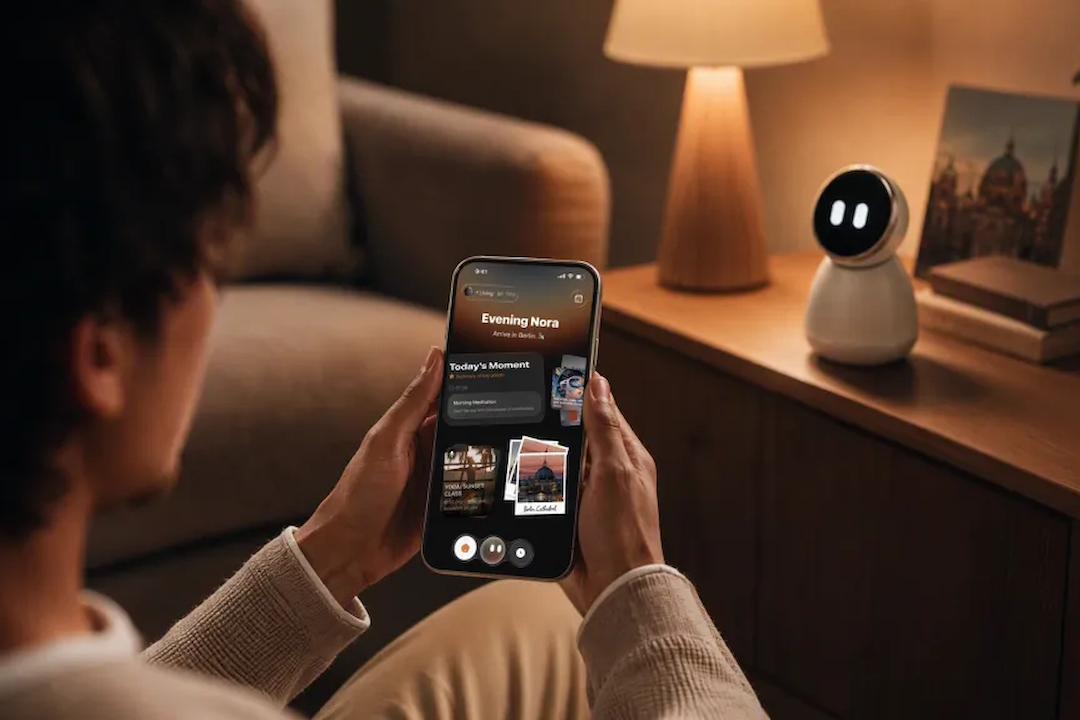
Lingverse, a Singapore-based smart hardware startup, revealed its modular AI wearable, iKairos, at IFA 2026 in Berlin on September 3, alongside LifeOS, the AI operating system that powers it. The company says it has raised $29 million in Pre-A funding. iKairos is built around what Lingverse calls a Neural Core, a circular pendant module that can be inserted into different physical bodies; at launch, it will ship housed inside a small desktop robot and can also be removed and worn as a necklace pendant, giving the same underlying AI a different vantage point depending on which form it’s in.
What LifeOS Is Actually Trying to Do
According to Lingverse, LifeOS continuously observes a user’s routines, preferences, and even their relationships and conversations, building context over time rather than only responding to a single prompt the way a voice assistant does. The company describes this as centralizing observations about how someone works and lives alongside the situations those behaviors occur in, aiming to surface relevant suggestions or notice patterns a person might not catch on their own. That’s a meaningfully different design goal than most current wearable AI devices, which tend to focus on a single input, usually audio, rather than combining multiple simultaneous perspectives on a user’s environment and behavior. Because the desktop robot and the pendant offer physically different vantage points on a user’s life, one observing a workspace, the other moving with the person, Lingverse’s pitch is that switching between the two forms gives the same underlying AI a broader picture than a single fixed device could gather on its own.
One Example, Clearly Marked as Hypothetical
The release illustrates this with a hypothetical scenario, not a demonstrated result: it describes iKairos potentially noticing that a user keeps bringing up an interest in sailing but never acts on it, and, combined with information it has about the user’s occasional shoulder pain, suggesting a beginner lesson at a local boathouse. A separate example describes the device recalling the visual details of an object a designer noticed in passing, saving them from digging through their phone’s photo gallery later. Lingverse presents both as examples of what LifeOS is designed to eventually do, not as something the system has actually been shown doing with real users. That distinction matters given the product is still pre-launch and only open for waitlist signups, with no price or ship date disclosed.
The Privacy Engineering Is the Most Concrete Part of This Release
Separate from the more speculative capability claims, Lingverse describes specific, checkable privacy engineering choices: a physical camera shutter, a privacy indicator light, and a manual mute button that give users direct control over when the device is capturing audio or video. Voice detection and capture are handled locally on the device itself, and when cloud processing is required, the release says data is encrypted both in transit and at rest, and is not used to train Lingverse’s underlying AI model. Users can also adjust how long their raw data is retained and delete individual records or their full account data at any time. These are the kind of concrete engineering commitments that matter more for an always-on, multi-sensor wearable than for a typical smartphone app, given how much more personal context a device like this is designed to continuously collect, and a physical shutter or mute button in particular gives a user a way to verify a device is off without having to trust a software setting alone.
The Longer-Term, More Speculative Vision
Lingverse frames iKairos as an early step toward what it calls embodied intelligence, the idea that the same core AI, carrying an existing understanding of a specific user’s habits and preferences, could eventually move into other robotic forms beyond the initial desktop robot and pendant. CEO Jiawei Gu described this as a foundation that could extend the AI’s context across future wearables, desktop devices, and robotics generally, so that a future robot could draw on an existing understanding of a user simply by having the Neural Core plugged into it, rather than starting from nothing. That’s a long-term roadmap statement about where the company hopes to go, not a description of a product that exists today, and Lingverse doesn’t attach a timeline to it or name any specific future hardware partners who might build the robotic bodies such a core would eventually plug into.
What’s Company Framing vs. What’s Verified
Lingverse’s description of iKairos as “the world’s first dual-perspective personal AI wearable” is the company’s own characterization and has not been independently verified against the broader wearable AI market. The $29 million funding figure and the IFA 2026 debut are both specific, checkable facts; the actual performance of LifeOS’s contextual reasoning, beyond the hypothetical example described above, is not something this article can independently assess, since the product has not yet shipped to any users.
Sources
Lingverse Debuts Ensouled AI Operating System, LifeOS, in First Public Look at Modular AI Wearable iKairos, PRNewswire, September 3, 2026.
Editorial Disclosure
This article is based on a press release issued by iKairos (Lingverse) on September 3, 2026, distributed via PRNewswire. Lingverse is a privately held company; no securities are discussed in this article and no ticker or exchange applies. Next Gen Tech Stocks was not compensated for this coverage. The scenario used to illustrate LifeOS’s contextual reasoning capability is presented by the company as a hypothetical example, not a demonstrated result with real users, and this article treats it as such. Claims describing iKairos as “the world’s first dual-perspective personal AI wearable” and Lingverse’s long-term “embodied intelligence” vision are the company’s own characterization and have not been independently verified. This article is for informational and educational purposes only. See our full Disclaimer.